
Bringing Socials, Apps, and Software Into One Workflow
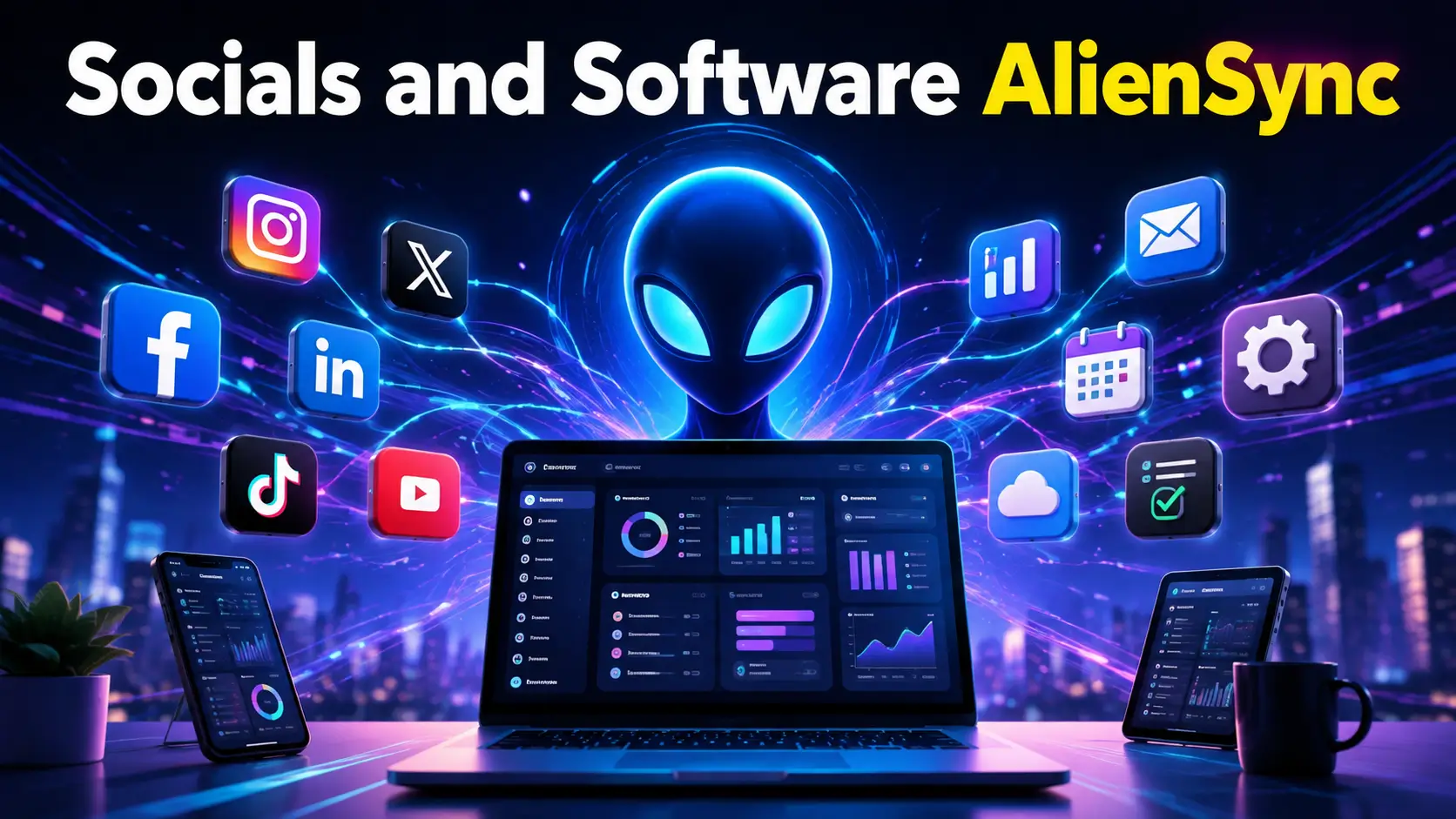
Socials and Software AlienSync can help organize social media accounts, apps, and software tools in one connected workflow, reducing repeated tasks. Instead of constant tab-switching, users can plan, create, post, and track content through a connected dashboard. This can save time, improve focus, and support better digital productivity. For social media management, connecting social networks, social accounts, and social platforms can also make daily work easier.
A clear digital workflow can improve efficiency, consistency, and workflow efficiency when teams manage many accounts. Useful processes include content planning, content creation, content publishing, content tracking, social media scheduling, and analytics tracking. App integration, software integration, and platform integration can reduce repetitive digital tasks while supporting cross-platform management and a stronger social media strategy.
Users should still verify specific AlienSync.com claims before connecting accounts. Check the verified AlienSync app, Apple App Store, Google Play, registration system, and public registration details first. Review digital identity, online identity, permissions, alternatives, and practical tips before using any platform for business or personal social management.
What Is Socials and Software AlienSync?
The phrase Socials and Software AlienSync is used online to describe the intersection of social platforms, applications, software tools, and digital connectivity.
However, it doesn’t currently point to one universally documented product with a single feature list.
The clearest distinction comes from the domains using the AlienSync name. aliensync.com describes itself as a technology-focused editorial platform. Its coverage includes blockchain and crypto, apps and social platforms, software, and broader technology developments.
By contrast, aliensync.io presents itself as an integration platform designed to connect systems, automate workflows, and reduce data silos. Its own material describes services involving cloud synchronization, API and data integration, workflow automation, and enterprise system architecture.
That means you shouldn’t automatically treat every article using the AlienSync name as evidence of one software product.
| What you find | What the available information indicates |
| aliensync.com | Technology and digital-media publication |
| aliensync.io | Presents itself as an integration and automation platform |
| Third-party AlienSync articles | Often describe additional features that aren’t independently documented |
| Social-media management claims | Appear in several articles but require verification |
| Public pricing | No clear, consistent pricing information is documented for the integration platform |
| Named integrations | No comprehensive, independently verified list is publicly established |
This is the first major point readers should understand. Brand similarity does not automatically mean product identity.
AlienSync as a Technology and Social Software Topic
The .com publication organizes its content around areas such as apps, social platforms, software, blockchain, crypto, and technology. Its stated purpose is to help readers understand developments across those categories.
That makes “socials and software” a natural editorial category for the site.
It doesn’t, by itself, prove that the website provides a social media management application.
AlienSync as an Integration Concept
The .io website takes a different approach. It describes an integration platform intended to make different systems communicate with one another.
Its stated services include:
- Custom cloud syncing
- API and data integration
- Workflow automation
- Enterprise system architecture
- Software infrastructure and telemetry
The central idea is straightforward: instead of keeping every application isolated, connect systems so information or actions can move between them.
That concept is common in modern business technology. The important question is whether a particular implementation provides the integrations, reliability, security, and documentation a business needs.
How AlienSync Is Supposed to Connect Socials and Software
At a conceptual level, software synchronization means creating a controlled connection between separate digital systems.
Imagine a company using a customer relationship management system, email platform, cloud database, and social accounts. Without integrations, employees may have to copy information manually from one system to another.
A synchronization workflow can reduce that repetitive work.
A simplified process looks like this:
Connect → Authorize → Synchronize → Automate → Monitor → Optimize
The exact workflow depends on the applications involved.
Connecting Social Accounts
A genuine social integration normally requires some form of authorized access.
Modern platforms commonly use APIs and authorization systems to let approved applications perform specific actions. Instead of handing a third-party application your social-media password, you may authorize defined permissions through the platform itself.
Those permissions can vary significantly.
For example, one integration might only read analytics. Another might publish content. A more extensive integration could manage messages, account information, or other approved data.
The permission scope matters more than the word “integration.”
Before connecting an account, users should ask:
- What information can the application access?
- Can it publish content?
- Can it read messages?
- Can it modify account settings?
- Can access be revoked?
- How long does the service retain connected data?
Synchronizing Information Across Tools
Synchronization doesn’t necessarily mean that everything updates everywhere instantly.
Depending on the technology, synchronization can happen through scheduled jobs, webhooks, API requests, queues, or other automated processes.
For example, a business might want a new customer record to trigger another internal action. A properly configured workflow can pass the required information between systems without requiring someone to copy and paste it manually.
However, real-time synchronization should never be assumed simply because a platform uses the word “sync.”
The speed depends on the connected services, API limitations, network conditions, processing rules, and the integration architecture.
Managing Activity From One Workflow
The biggest practical advantage of synchronization is reducing context switching.
Instead of repeatedly opening several applications, a user can create workflows around specific tasks.
For example:
- A customer submits information.
- The information enters the appropriate business system.
- An automated workflow processes the record.
- Another connected application receives the required data.
- The team receives an alert.
- Staff members handle the next step.
This approach can save time when the workflow is repetitive and predictable.
What Features Are Associated With AlienSync?
Several websites describe AlienSync with features such as multi-account management, automation, synchronization, analytics, and cross-platform support.
But there’s a crucial distinction between a published feature claim and a verified product capability.
The current public material for the integration-focused AlienSync site itself says that commonly associated features include real-time synchronization, customizable workflows, multi-account management, encrypted data transfer, no-code or low-code setup, and cross-platform support. However, the same material acknowledges that these capabilities are not independently confirmed through detailed technical documentation or third-party verification.
That means readers should evaluate these features carefully.
Multi-Platform Social Management
Managing several social accounts from a central interface can be useful.
A social-media manager, for example, may handle multiple brand profiles across several networks. A centralized workflow could reduce repeated login and publishing tasks.
But actual support depends on official integrations.
A platform might support one social network for publishing while offering another only for analytics. Another network may not be supported at all.
So a reliable evaluation should look for named platforms and documented capabilities, not vague claims of “multi-platform support.”
Content Scheduling and Distribution
Scheduling is one of the most common functions associated with social-management software.
A typical scheduler lets users prepare content in advance and assign publication dates.
However, cross-platform publishing isn’t always identical. Each network has its own content formats, API rules, character limits, media requirements, and publishing restrictions.
That creates an important distinction:
Centralized publishing doesn’t mean identical publishing.
Good software should account for those differences rather than blindly duplicating the same content everywhere.
Content Repurposing
Content repurposing means adapting one original idea into several formats.
For example, a long article could become:
- A short social post
- A carousel
- A video script
- A newsletter section
- A discussion prompt
This can improve efficiency, but automated repurposing still requires editorial judgment.
A platform may help transform content. It can’t automatically understand every brand’s tone, audience, positioning, and compliance requirements perfectly.
Unified Notifications and Social Activity
Centralized notifications can reduce the need to constantly check multiple applications.
For a business, that could make it easier to identify:
- New customer messages
- Mentions
- Engagement activity
- Workflow failures
- Account alerts
- Publishing issues
The value comes from prioritization, not simply collecting more notifications in one place.
If a system produces hundreds of alerts without filtering them, centralization can actually create another layer of noise.
Software and API Integrations
API integration is one of the more technically meaningful concepts associated with AlienSync.
An API allows software systems to communicate through defined rules. It can let one application request information from another or send approved data to it.
For example, a workflow could theoretically connect:
CRM → Automation Layer → Database → Reporting System
The specific applications and actions depend on available integrations.
This is why businesses should ask for a complete named integration list before adopting an unfamiliar platform.
Analytics and Reporting
Analytics can help businesses understand whether their social activity produces meaningful results.
Useful metrics may include:
| Metric | What it tells you |
| Reach | How many people encountered the content |
| Impressions | How often content was displayed |
| Engagement rate | How actively users interacted with content |
| Click-through rate | How often viewers clicked a link or call to action |
| Follower growth | Whether the audience is expanding |
| Conversion rate | Whether activity contributes to a desired action |
| Response time | How quickly a team handles customer interactions |
Analytics become valuable when they support decisions.
A dashboard filled with numbers isn’t automatically useful. The important question is whether those numbers help you decide what to publish, change, stop, or improve.
AlienSync Social Card and Digital Identity Management
Some third-party articles associate AlienSync with a “social card” or centralized digital identity hub.
The concept itself is easy to understand.
A digital identity hub can collect important online information in one place, such as:
- Social profiles
- Professional details
- Contact information
- Brand information
- Portfolio pages
- Communication channels
This resembles the broader category of digital business cards and link-in-bio tools.
However, readers should distinguish between a concept discussed in third-party content and a documented current AlienSync feature.
A feature should be treated as confirmed only when the relevant product documentation, interface, or official product material clearly supports it.
That approach prevents one of the biggest problems in technology content: repeating an unverified feature until it starts looking like fact.
Who Could Benefit From AlienSync?
A synchronization platform can make sense for people whose work already involves several connected systems.
Small Businesses
Small businesses often operate with limited staff.
One person may handle marketing, customer communication, sales, reporting, and administration. Reducing repetitive tasks can therefore have a meaningful impact.
A synchronization tool could be useful when the same information repeatedly moves between several applications.
Content Creators
Creators often manage multiple profiles and content formats.
A centralized workflow could help organize publishing schedules, content ideas, audience interactions, and performance data.
Still, creators should prioritize platforms that support the networks where their audiences actually spend time.
Personal Brands
Professionals building personal brands can benefit from organized digital profiles and consistent publishing.
A centralized system can help maintain a repeatable workflow across social platforms.
The goal shouldn’t be to publish everywhere simply because the technology allows it.
Audience fit should determine platform selection.
Marketing Teams
Marketing teams can benefit when several people need access to the same workflow.
Useful capabilities may include:
- Shared publishing calendars
- Approval processes
- Analytics
- Account permissions
- Automated workflows
- Campaign reporting
Team features become especially important as the number of accounts increases.
Agencies
Agencies face a different challenge because they manage multiple clients.
A good system needs more than basic publishing. It should make account separation, permissions, reporting, and workflow management clear.
Before adopting any unfamiliar platform, an agency should test whether one client’s information can remain completely isolated from another client’s data.
AlienSync for Businesses: Is It Actually Useful?
The underlying problem AlienSync describes is real: workflow fragmentation.
Businesses commonly use dozens of software products. Research published by SaaS management providers has repeatedly shown that organizations can accumulate large software stacks over time.
Every additional application can create another login, another data source, another notification system, and another workflow.
Integration can reduce that complexity.
But integration only creates value when it works reliably.
The public AlienSync material itself acknowledges a major gap: several advertised capabilities lack detailed public verification, while pricing and named integrations aren’t clearly documented.
That makes due diligence especially important.
Questions Businesses Should Ask Before Using It
Before connecting business-critical systems, ask:
- Which applications are officially supported?
- Which social platforms are supported?
- What actions can each integration perform?
- Is the integration read-only or write-enabled?
- What permissions are required?
- How is data encrypted?
- Where is data stored?
- How long is data retained?
- What happens when an API changes?
- Is customer support available?
- What does the service cost?
- Are there usage or account limits?
- Can connected accounts be disconnected easily?
A vendor that answers these questions clearly gives you far more confidence than one that simply lists impressive-sounding features.
Is AlienSync Safe?
Security deserves particular attention because synchronization tools can sit between multiple systems.
A single integration may potentially gain access to business information, customer records, social accounts, or internal workflows.
The AlienSync integration site makes security-related claims, including enterprise-grade encryption. However, the available public material does not establish a comprehensive set of independent certifications such as SOC 2 or ISO certification.
That doesn’t automatically mean a platform is unsafe.
It means users should verify the security architecture instead of relying on marketing language.
Security Checks Before Connecting an Account
Use this basic checklist:
- Verify the domain. Make sure you’re dealing with the intended company or product.
- Review permissions. Don’t grant access you don’t need.
- Use official authorization. Avoid entering social-media passwords into unfamiliar forms.
- Enable two-factor authentication. Protect the original account independently.
- Read the privacy policy. Look for data collection and retention details.
- Check revocation options. Make sure you can remove access later.
- Test with low-risk data. Don’t begin with your most sensitive systems.
- Monitor activity. Review account logs and connected applications regularly.
Privacy and Data Considerations
Security and privacy aren’t identical.
Security asks whether unauthorized parties can access information. Privacy also asks what the provider does with information it legitimately receives.
Before using an integration platform, determine:
- What data it collects
- Why it collects that data
- Whether it shares data
- How long it keeps information
- Whether users can request deletion
- Where information is processed
- Whether third-party processors are involved
These details matter even more for businesses handling customer information.
What Are the Limitations of AlienSync?
The biggest limitation isn’t necessarily technical.
It’s uncertainty around the product’s publicly documented capabilities.
The available information describes AlienSync in several different ways, including an integration platform, social-management tool, technology publication, and broader digital ecosystem. The integration-focused site itself recognizes this inconsistency.
That makes verification essential.
Other practical limitations apply to almost every synchronization platform.
Social Platforms Have Their Own Rules
A third-party application cannot simply ignore the rules of the social network it connects to.
APIs can restrict:
- Publishing frequency
- Available data
- Account permissions
- Message access
- Analytics
- Media formats
When a social platform changes its API, connected software may also need updates.
Integrations Can Break
A workflow is only as reliable as its weakest connection.
For example:
Social platform → Integration → CRM → Reporting tool
If one service changes its API, the entire chain may require adjustment.
That means automation should always include monitoring and failure handling.
More Automation Creates New Failure Points
Automation reduces repetitive work, but it also introduces dependencies.
A failed workflow could:
- Duplicate information
- Miss an update
- Send incorrect data
- Delay a customer response
- Publish the wrong content
- Create inconsistent records
For important business processes, automation should include checks rather than running completely unattended.
Why “All-in-One” Doesn’t Always Mean “Better”
An all-in-one platform sounds attractive because it promises simplicity.
But specialization has advantages too.
A dedicated social-media tool may offer deeper publishing and analytics features. A dedicated CRM may provide more advanced customer management. A dedicated automation platform may support a much larger integration ecosystem.
The best solution depends on the problem.
| Need | What to prioritize |
| Social publishing | Scheduling, platform support, content tools |
| Workflow automation | Integrations, triggers, actions, reliability |
| Customer management | CRM features and data controls |
| Reporting | Accurate analytics and customizable reports |
| Team collaboration | Roles, approvals, permissions |
| Enterprise integration | Security, APIs, compliance, support |
Don’t choose a tool because it claims to do everything.
Choose it because it does your important tasks reliably.
How to Evaluate AlienSync Before You Use It
A careful evaluation can take less time than recovering from a failed integration.
Verify the Official Product
Start with the exact domain and company identity.
This is particularly important because several websites use similar AlienSync names. The .com site identifies itself as a technology publication, while the .io site presents a software integration service.
Never assume two similarly named websites are the same company.
Check Supported Platforms
Ask for specific names.
“Works with social platforms” is too vague.
You want to know whether it supports the exact services your business uses and what each integration can actually do.
Review Pricing and Limits
Public information about the integration-focused AlienSync offering does not provide a clear, detailed pricing structure. The available material indicates that pricing varies depending on usage and features.
Before paying, request:
- Monthly cost
- Annual cost
- User limits
- Account limits
- Workflow limits
- Data limits
- Premium features
- Setup charges
- Cancellation terms
Get important commercial terms in writing.
Test With a Low-Risk Account
Don’t connect your entire digital infrastructure on day one.
Start with a limited workflow.
For example, test one social account and one non-critical application. Run the workflow for several days and inspect the results.
Look for:
- Failed automations
- Duplicate records
- Delayed updates
- Incorrect formatting
- Unexpected permissions
- Poor support responses
A controlled test provides more useful evidence than a promotional feature list.
Common Mistakes People Make With Socials and Software AlienSync
Assuming Every Claimed Feature Is Available
Third-party articles can repeat the same claims across dozens of pages.
Repetition doesn’t make a feature official.
Always look for current product documentation or direct confirmation.
Connecting Every Account Immediately
More connections mean more risk.
Start small. Expand only after the initial workflow proves reliable.
Ignoring Platform-Specific Rules
A social network may restrict what third-party applications can publish or access.
Don’t assume a synchronization tool can bypass those restrictions.
Treating Automation as a Replacement for Strategy
Automation can distribute content.
It can’t decide whether the content is useful to your audience.
You still need:
- Audience research
- Content strategy
- Brand positioning
- Editorial review
- Performance analysis
Forgetting to Monitor Connected Accounts
Automation shouldn’t mean abandonment.
Review important workflows regularly and investigate unexpected activity immediately.
How to Get Better Results From a Social-Sync Workflow
The best synchronization strategy starts with a specific business problem.
Suppose a marketing team spends two hours every day copying information between applications.
That’s a measurable problem.
If automation reduces that work to 30 minutes, the business can compare the time saved against the software cost and implementation effort.
This is much better than adopting automation simply because it sounds modern.
Start With Your Core Platforms
Identify the two or three platforms that consume the most manual effort.
Don’t try to automate everything at once.
Standardize Your Workflow
Create clear steps for:
Creation → Review → Approval → Publishing → Monitoring → Reporting
A standardized process makes automation easier to maintain.
Adapt Content Instead of Blindly Duplicating It
A LinkedIn post, Instagram caption, and short-form video description may communicate the same idea differently.
Use synchronization to reduce repetitive work, not to eliminate editorial judgment.
Track Meaningful Metrics
Don’t measure success only through follower counts.
Look at metrics connected to your actual objective.
For a lead-generation campaign, conversions may matter more than impressions.
For customer support, response time may matter more than follower growth.
For brand awareness, reach and engagement may deserve more attention.
Audit Integrations Regularly
Technology changes.
Review connected systems periodically to make sure:
- Permissions remain appropriate.
- Integrations still work.
- Unused accounts are removed.
- Workflows still match business needs.
- Security policies remain acceptable.
Is AlienSync Worth Using in 2026?
The answer depends on which AlienSync you mean and what you need it to do.
If you’re referring to the technology publication at aliensync.com, its role is primarily editorial. The site covers apps, social platforms, software, blockchain, crypto, and technology trends.
If you’re evaluating the integration platform presented at aliensync.io, the proposition is different. It describes cloud synchronization, API integration, workflow automation, and related services.
The technology concept is legitimate. Connecting applications, automating workflows, and reducing manual data entry are established practices.
The question is whether the specific service delivers those capabilities with enough transparency and reliability for your needs.
At present, the public information leaves several important questions open. Those include detailed pricing, named integrations, independent reviews, and independently verifiable security credentials.
That doesn’t mean you should automatically reject the platform.
It means you should test before trusting.
For a casual workflow, a cautious trial may be reasonable. For sensitive customer data, financial systems, or business-critical accounts, demand much stronger documentation first.
Conclusion
Socials and Software AlienSync represents the broader idea of connecting social platforms, apps, and software to make digital work easier. A well-organized workflow can reduce app switching, repetitive tasks, and wasted time while improving content management and productivity. However, users should verify AlienSync’s current features, official identity, supported platforms, security practices, and account permissions before connecting important social accounts. The best approach is simple: test the service carefully, use only the features you actually need, and choose a workflow that makes your daily social media management faster without adding unnecessary complexity.
Frequently Asked Questions About Socials and Software AlienSync
Q1.What is Socials and Software AlienSync?
Socials and Software AlienSync refers to the idea of connecting social networks, apps, and software tools within a more organized digital workflow. The goal is to reduce repetitive work and make social media management easier.
Q2.Is AlienSync a social media management platform?
AlienSync is discussed online in connection with social media, software, and digital technology. However, users should verify the current product identity and available features before treating it as a complete social media management platform.
Q3.Can AlienSync connect multiple social media accounts?
The broader AlienSync concept focuses on connecting social accounts and software systems. Before connecting multiple accounts, check the current supported platforms, account limits, permissions, and available integrations.
Q4.Is there a verified AlienSync app?
Users should verify whether an official AlienSync application is currently available through trusted app stores. Check the Apple App Store and Google Play carefully before downloading an application or entering account information.
Q5.Is AlienSync safe to use?
Safety depends on the specific service, permissions, security controls, and data practices involved. Review the privacy policy, requested account permissions, authentication methods, and official product information before connecting sensitive accounts.
Q6.Who can benefit from AlienSync?
Social media teams, creators, small businesses, and professionals who manage several apps or social accounts may benefit from a connected workflow. It can be especially useful when repetitive digital tasks consume significant time.
Q7.What should I check before using AlienSync?
Verify the official website and product identity first. Then check supported platforms, pricing, security practices, account permissions, registration details, integrations, and cancellation or access-revocation options before committing to the service.
Conclusion
Socials and Software AlienSync represents the broader idea of connecting social platforms, apps, and software to make digital work easier. A well-organized workflow can reduce app switching, repetitive tasks, and wasted time while improving content management and productivity. However, users should verify AlienSync’s current features, official identity, supported platforms, security practices, and account permissions before connecting important social accounts. The best approach is simple: test the service carefully, use only the features you actually need, and choose a workflow that makes your daily social media management faster without adding unnecessary complexity.
