
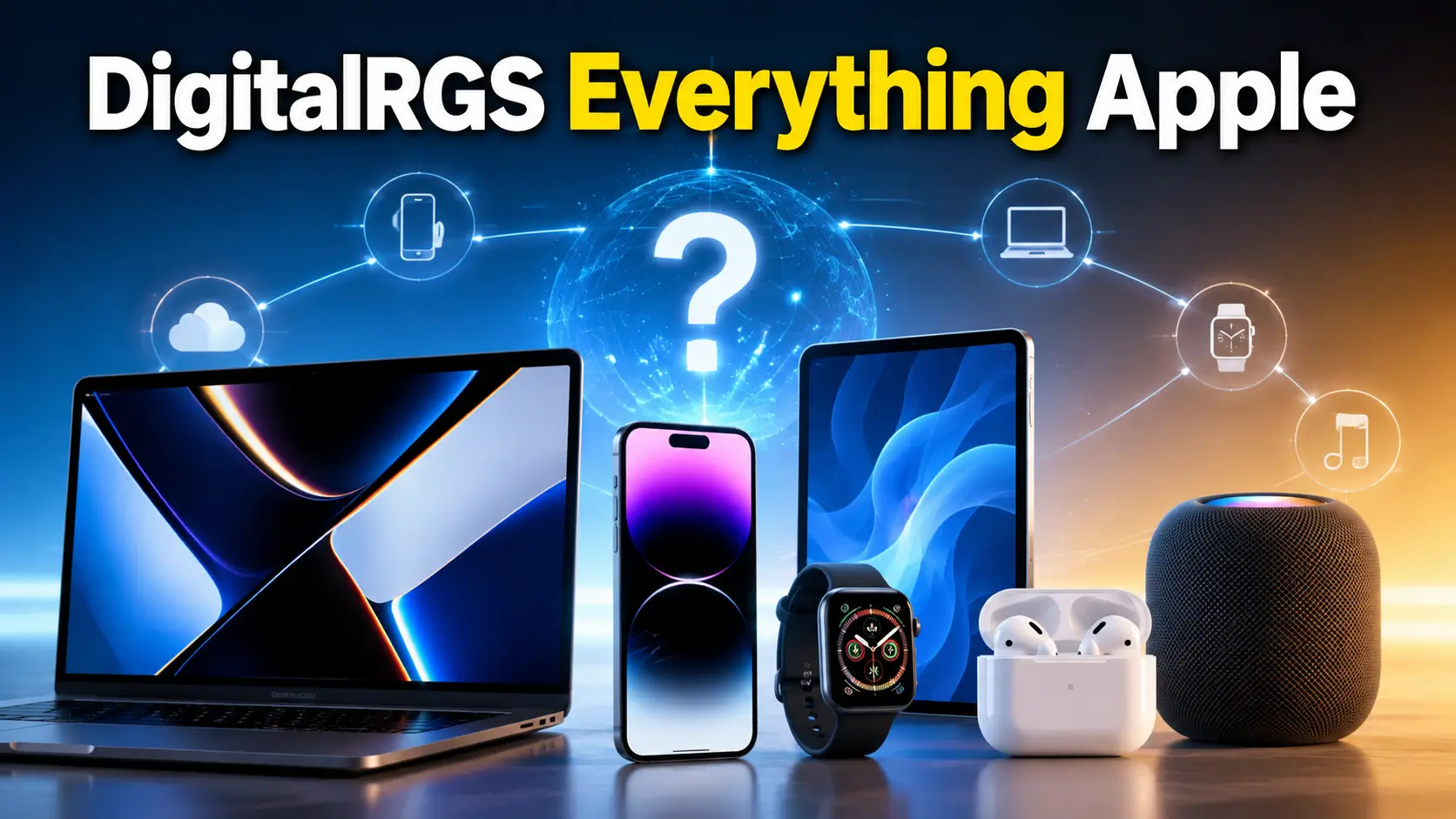

How the Apple Ecosystem Shapes the Modern Digital Experience
DigitalRGS Everything Apple helps users understand how Apple devices, software, and services connect for easier daily use.
Apple Inc. builds an integrated environment around the Apple ecosystem, linking the iPhone, Apple hardware, Apple software, Apple services, and other devices. This device integration can create a smoother digital experience, especially when you use multiple Apple products. Features such as Apple device connectivity, shared services, and cross-device workflow can improve daily productivity, reduce repeated tasks, and make the overall user experience simpler. For a first-time buyer, this also makes the buying decision easier because you can judge each product by how well it fits your actual needs.
The ecosystem also includes Apple Intelligence, Apple Intelligence features, and other modern AI tools that add useful functions to supported devices. Good Apple ecosystem tips should focus on real Apple features, practical feature usage, Apple usage, privacy, performance, and Apple ecosystem value. Instead of buying every product, users should choose the devices and services that improve their own workflow, productivity tools, and daily usage.
What Is DigitalRGS Everything Apple?
DigitalRGS Everything Apple refers to a broad Apple-focused topic covering products, software, services, features, ecosystem integration, buying advice, and practical troubleshooting.
It isn’t an Apple operating system, device, subscription, or built-in application. The phrase is better understood as a content and information topic centered on Apple’s technology landscape.
A useful Apple guide should answer questions such as:
- Which Apple device fits a particular need?
- How do Apple devices communicate with each other?
- What does iCloud actually do?
- Which Apple features are worth enabling?
- How does Apple Intelligence work?
- How can you protect an Apple Account?
- Which Apple services are useful?
- What should you check before buying an Apple product?
- How do you fix common connectivity and storage problems?
The important distinction is that Apple makes the products and services, while DigitalRGS Everything Apple describes the broader information users may seek about them.
Understanding the Apple Ecosystem
Apple’s ecosystem combines hardware, operating systems, cloud services, account features, and accessories.
The major pieces include:
| Apple product or service | Primary role |
| iPhone | Communication, photography, apps, mobile computing |
| iPad | Portable computing, media, education, creativity |
| Mac | Desktop and professional computing |
| Apple Watch | Fitness, notifications, communication, safety |
| AirPods | Wireless audio and hands-free communication |
| Apple TV | Streaming and home entertainment |
| HomePod | Music and smart-home audio |
| Apple Vision Pro | Spatial computing and immersive experiences |
| iCloud | Cloud storage, syncing, and backup |
| Apple Account | Identity across Apple’s services |
The ecosystem becomes most noticeable when you own two or more compatible Apple devices.
For example, you can copy text on an iPhone and paste it on a Mac using Universal Clipboard. You can start supported activities on one device and continue them on another with Handoff.
That interaction creates convenience that individual specifications don’t fully describe.
How Apple Devices Work Together
Several features form the backbone of Apple’s cross-device experience.
AirDrop lets you transfer photos, videos, documents, links, and other supported content between compatible nearby Apple devices.
Handoff allows supported activities to move between devices. You might begin reading something on an iPhone and continue on a Mac or iPad.
Universal Clipboard shares copied content between compatible Apple devices signed into the same Apple Account.
Universal Control allows a compatible Mac and iPad to share a keyboard and mouse or trackpad, making them feel more like parts of one workspace.
Continuity Camera can turn an iPhone into a camera source for a Mac in supported situations.
These features depend on compatible hardware, software versions, settings, and account configuration. Owning Apple products alone doesn’t guarantee that every feature will work.
Apple Devices: What Each Product Is Best For
Apple sells products for very different types of users. The best device isn’t necessarily the most expensive one.
Your workload should determine the hardware you buy.
iPhone: The Center of Everyday Apple Life
The iPhone serves as the central device for many Apple users.
It handles calls, messaging, photography, navigation, banking, payments, social apps, entertainment, authentication, and thousands of other tasks.
When comparing iPhone models, don’t focus only on the processor. Consider:
- Display size and quality
- Camera hardware
- Battery capacity and efficiency
- Storage
- Cellular features
- USB connectivity
- Processing performance
- Apple Intelligence compatibility
- Expected software support
- Repair and accessory costs
Storage deserves particular attention. A phone used heavily for 4K video, large games, and high-resolution photography can consume storage surprisingly quickly.
Practical example: A student who mainly uses messaging, browsing, documents, and photographs may not need the same iPhone configuration as a professional who records large video files.
iPad: Portable Power Without Being a Mac
The iPad occupies the middle ground between a smartphone and traditional computer.
Apple’s iPad lineup includes different models aimed at different budgets and workloads. The standard iPad suits everyday tasks, while the iPad Air and iPad Pro target users who need greater performance or advanced features. The iPad mini emphasizes compact size.
An iPad works particularly well for:
- Reading
- Note-taking
- Digital drawing
- Video streaming
- Education
- Web browsing
- Casual gaming
- Presentations
- Portable office work
- Creative applications
However, an iPad doesn’t automatically replace a Mac.
Some professional workflows depend on desktop software, extensive file management, specialized peripherals, or macOS-specific applications. For those users, a Mac remains the better primary computer.
Mac: Where Apple Silicon Changed the Formula
Modern Macs use Apple-designed silicon rather than the Intel processors found in older generations.
Apple Silicon changed the Mac’s balance between performance and power efficiency. Mac computers can deliver substantial processing capability while maintaining relatively low power consumption.
The MacBook Air targets portability and everyday productivity. MacBook Pro models focus more heavily on sustained professional workloads.
A Mac makes sense for:
- Programming
- Professional writing
- Video editing
- Graphic design
- Music production
- Business applications
- Research
- Multitasking
- Desktop productivity
The key buying question isn’t simply, “Which Mac is fastest?”
Instead, ask, “What workload will I run every day?”
A person writing documents and browsing the web may gain little from paying for hardware designed around demanding professional workloads.
Apple Watch: A Companion for the iPhone
Apple Watch extends many iPhone functions to your wrist.
It can display notifications, track workouts, support communication, provide navigation cues, and offer various health and safety features depending on the model and region.
Its biggest advantage isn’t raw computing power. It’s immediacy.
You can glance at information without pulling your phone from your pocket.
Apple Watch can be especially useful for:
- Fitness tracking
- Workout monitoring
- Notifications
- Timers and alarms
- Calls and messages
- Navigation
- Safety features
- Contactless payments
- Music controls
The Apple Watch experience remains closely tied to the iPhone, so Android users should consider compatibility before buying one.
AirPods: More Than Wireless Earbuds
AirPods are designed to integrate tightly with Apple devices.
Depending on the model, users can access features such as automatic switching, noise cancellation, transparency modes, spatial audio, and hands-free interactions.
Their ecosystem advantage becomes obvious when you move between Apple devices.
For example, you might listen to music from an iPhone and then use the same headphones with a Mac without treating the devices like completely separate systems.
The best AirPods model depends on whether you care most about:
- Basic wireless listening
- Active noise cancellation
- Transparency
- Spatial audio
- Battery life
- Fit
- Microphone performance
Apple TV and HomePod
Apple TV focuses on home entertainment, while HomePod products focus primarily on audio and smart-home interaction.
Apple TV can integrate with AirPlay and other Apple services, making it useful in households already using Apple devices.
HomePod can fit into an Apple-centered home through supported audio and smart-home functions.
Neither product is essential for enjoying an iPhone or Mac. They become more valuable when you want to extend the ecosystem into your living space.
Apple Vision Pro: Apple’s Spatial Computing Platform
Apple Vision Pro represents a different direction from conventional phones, tablets, and computers.
Instead of placing information on a traditional screen, spatial computing can position digital content around the user.
Its potential uses include:
- Immersive entertainment
- Large virtual workspaces
- 3D content
- Spatial video
- Productivity
- Interactive experiences
However, Vision Pro shouldn’t be treated as a universal replacement for an iPhone or Mac.
Its value depends heavily on the user’s needs, budget, available applications, comfort, and preferred computing environment.
Apple Operating Systems Explained
Apple maintains separate operating systems for different hardware categories.
The major platforms include:
- iOS for iPhone
- iPadOS for iPad
- macOS for Mac
- watchOS for Apple Watch
- tvOS for Apple TV
- visionOS for Apple Vision Pro
Although these systems share design ideas and ecosystem services, they aren’t interchangeable.
A feature introduced on iPhone may not appear on an older iPhone or an iPad. Some features require specific processors, cameras, sensors, or other hardware.
This is especially important with AI features.
Buying tip: Never assume that a software feature will reach every Apple device simply because both devices can install a particular operating-system update.
Apple Intelligence: Apple’s AI Features Explained
Apple Intelligence is Apple’s collection of artificial intelligence features integrated into supported devices and operating systems.
It isn’t simply one chatbot. Instead, Apple uses AI across several functions.
Writing Tools
Writing Tools can help users rewrite, proofread, summarize, or adjust text in supported contexts.
This can help with:
- Emails
- Notes
- Messages
- Documents
- Professional communication
The important point is that these features are designed to work within Apple’s software environment rather than existing only as a separate AI application.
Notification Summaries
AI can help condense groups of notifications so users can understand important information faster.
This can be useful when a device receives many messages, emails, or other alerts throughout the day.
However, summaries can occasionally miss nuance. Important information should still be checked directly when accuracy matters.
Siri Improvements
Apple has been expanding Siri’s capabilities with more natural interactions and deeper system integration.
The practical goal is simple: make voice interaction more useful when users want to perform actions without navigating multiple menus.
Availability varies according to device, software version, language, and region.
Image Playground and Genmoji
Apple’s AI tools also extend into image creation and personalized emoji-style content.
Genmoji lets supported users create customized emoji concepts from descriptions.
Image-generation features provide another way to create visual content directly within Apple’s software environment.
Private Cloud Compute
Apple has emphasized a hybrid approach to AI processing.
Some tasks can run directly on the device. More demanding tasks may use Apple’s cloud infrastructure when necessary.
Apple calls its privacy-focused cloud approach Private Cloud Compute.
The broader idea is important: AI doesn’t always have to mean sending every piece of information to an ordinary third-party cloud service.
iCloud: The Backbone Behind Apple’s Connected Experience
iCloud is one of the least visible but most important parts of the Apple ecosystem.
It can synchronize information across compatible devices and provide cloud storage for files, photos, backups, and other data.
Common iCloud functions include:
- Photos synchronization
- iCloud Drive
- Contacts
- Calendars
- Notes
- Passwords and Keychain
- Device backups
- Find My
- Messages in supported configurations
One common misunderstanding is that device storage and iCloud storage are the same thing.
They aren’t.
Your iPhone might have a certain amount of physical storage while your iCloud account has a separate storage allocation.
If your iPhone is full, buying iCloud storage doesn’t magically increase the phone’s physical storage. It can help you move or synchronize certain content, but local storage still matters.
The Most Useful Apple Continuity Features
Apple’s ecosystem becomes much more valuable when you actually use its integration features.
| Feature | What it does |
| AirDrop | Transfers supported files between nearby Apple devices |
| Handoff | Continues supported activities on another device |
| Universal Clipboard | Shares copied content between devices |
| Universal Control | Uses one input setup across compatible Mac and iPad devices |
| AirPlay | Streams or mirrors supported content |
| Continuity Camera | Uses iPhone camera capabilities with supported Mac functions |
| Instant Hotspot | Makes connecting compatible Apple devices easier |
| iPhone Mirroring | Allows supported Mac users to interact with an iPhone through the Mac |
These features can remove dozens of small steps from everyday work.
Case study: Imagine someone writing an article on a Mac while researching on an iPhone. They can copy a useful piece of information on the phone, paste it on the Mac, send a photo through AirDrop, and continue supported activities using Handoff. None of those actions requires manually emailing files to themselves.
That is the practical value of the ecosystem.
Hidden Apple Features Worth Enabling
Some of Apple’s most useful features aren’t obvious.
Live Text
Live Text can recognize text inside supported photos and images.
Depending on the context, you may be able to copy text, translate it, identify information, or interact with detected content.
This becomes particularly useful for receipts, signs, documents, screenshots, and printed material.
Back Tap
On supported iPhones, Back Tap can trigger actions when you double-tap or triple-tap the back of the device.
Possible actions include screenshots, accessibility functions, shortcuts, and other supported commands.
Focus Modes
Focus modes let you control notifications around activities such as work, sleep, exercise, or personal time.
Instead of manually dismissing notifications throughout the day, you can create rules around when certain alerts should appear.
Hide My Email
Hide My Email can create unique email addresses that forward messages to your actual inbox.
This can help reduce the need to give your primary address to every website or service.
Shortcuts
Shortcuts can automate repetitive actions.
For example, you could create workflows for:
- Starting a work routine
- Sending a predefined message
- Opening several apps
- Converting files
- Running repeated actions
- Controlling supported smart-home functions
Automation becomes especially valuable when you repeat the same sequence every day.
Apple Privacy and Security
Apple places considerable emphasis on privacy and device security, but users still need to configure their devices responsibly.
Important security features include:
- Face ID or Touch ID
- Two-factor authentication
- Secure Enclave
- App permission controls
- Find My
- Stolen Device Protection
- Safety Check
- Lockdown Mode
- Security updates
- Advanced Data Protection for supported iCloud data
A secure device isn’t created by one feature.
It results from several layers working together.
Strong account security matters just as much as device security. If someone gains access to your Apple Account, they may gain access to sensitive synchronized information.
Use a strong password and enable two-factor authentication.
Apple Accessibility Features
Accessibility is one of Apple’s strongest software areas because many accessibility tools are built directly into its operating systems.
Examples include:
- VoiceOver
- Voice Control
- Magnifier
- AssistiveTouch
- Switch Control
- Display adjustments
- Text-size controls
- Hearing-related features
- Live Captions where supported
These tools aren’t useful only for people with permanent disabilities.
A person recovering from an injury, working in a noisy environment, experiencing temporary vision difficulty, or simply wanting larger text can also benefit from accessibility controls.
Setting Up an Apple Ecosystem Properly
A good setup begins before you install dozens of apps.
Start with your Apple Account and enable two-factor authentication.
Then configure iCloud services based on what you actually need.
A sensible setup includes:
- Sign in with the correct Apple Account.
- Enable two-factor authentication.
- Set up Find My.
- Configure iCloud backups.
- Review Photos and iCloud Drive settings.
- Enable useful Continuity features.
- Configure Face ID or Touch ID.
- Review app permissions.
- Set up Family Sharing if appropriate.
- Install only the apps you actually need.
This approach prevents a common problem: users buy several Apple products but never configure the ecosystem features that make those products work better together.
Apple Ecosystem for Families
Family Sharing can connect eligible purchases, subscriptions, location features, and other family-related functions under Apple’s family framework.
Screen Time can help parents manage device usage and review activity.
Family-oriented Apple features can be useful for:
- Managing children’s screen time
- Sharing eligible subscriptions
- Sharing purchases
- Finding family devices
- Coordinating calendars
- Managing certain parental controls
The exact controls depend on device type, software version, account configuration, and the age settings associated with family members.
Choosing the Right Apple Device
The smartest Apple purchase starts with a use case.
| Your primary need | Apple device to consider |
| Everyday mobile use | iPhone |
| Portable reading and notes | iPad |
| Desktop productivity | Mac |
| Professional computing | MacBook Pro or Mac desktop |
| Fitness and wrist notifications | Apple Watch |
| Wireless audio | AirPods |
| Home streaming | Apple TV |
| Spatial computing | Apple Vision Pro |
Don’t automatically buy the highest-tier model.
A student who writes essays and browses the web may have no practical reason to purchase a professional workstation. Likewise, a video editor working with demanding projects shouldn’t choose hardware based solely on the lowest price.
What to Check Before Buying
Consider these factors:
- Performance: Match the processor to your workload.
- Storage: Large photo, video, and game libraries need more space.
- Battery: Important for mobile users.
- Display: Consider size, brightness, resolution, and refresh rate where relevant.
- Accessories: Keyboards, pencils, chargers, and cases can increase the real cost.
- Compatibility: Check whether your existing devices support the features you want.
- Software support: Older hardware eventually loses access to newer capabilities.
- Repairability and service: Consider long-term ownership, not only the purchase price.
Apple vs Android and Windows
Apple’s ecosystem isn’t automatically better for everyone.
Its biggest strength is integration.
Android offers devices from many manufacturers, while Windows provides a broad range of computers and hardware configurations. Those platforms can offer more price variety, customization, and hardware choice.
Apple often stands out when users value:
- Consistent hardware and software integration
- Cross-device continuity
- Long-term ecosystem familiarity
- Strong accessory integration
- Centralized account management
- Tight control over the hardware and software experience
Android and Windows may be better for users who prioritize:
- Wider hardware selection
- Greater customization
- Lower-cost options
- Specialized hardware
- Certain gaming environments
- Broader compatibility with non-Apple equipment
The best ecosystem is the one that matches your actual workflow.
Common Apple Problems and Easy Fixes
Even polished ecosystems experience technical problems.
AirDrop Isn’t Working
Check that the devices are nearby and have the required wireless connections enabled. Also verify AirDrop receiving settings and whether the devices meet compatibility requirements.
iCloud Storage Is Full
Review which categories consume the most space.
Photos, device backups, large files, and messages can become major storage users. Delete unnecessary content or increase storage if you genuinely need more capacity.
AirPods Won’t Connect
Place the AirPods back in their charging case, check Bluetooth settings, ensure sufficient battery, and reconnect them. Persistent problems may require resetting the pairing process.
The Mac or iPhone Feels Slow
Start with basic checks:
- Restart the device.
- Install available software updates.
- Check available storage.
- Identify unusually demanding apps.
- Check battery condition where applicable.
- Remove apps you no longer use.
Avoid random “speed booster” applications that promise to transform Apple hardware.
Apple Devices Aren’t Syncing
Check whether all devices use the intended Apple Account and whether the relevant iCloud settings are enabled.
Also check network connectivity and software compatibility.
Keeping Apple Devices Fast, Secure, and Reliable
Apple devices don’t require complicated maintenance routines.
A sensible routine includes:
- Install important software updates.
- Keep reasonable free storage.
- Maintain current backups.
- Review account security.
- Check privacy permissions.
- Remove unused applications.
- Monitor battery condition.
- Protect devices from extreme heat and physical damage.
You don’t need to constantly clear caches or install optimization utilities.
Modern Apple operating systems handle many maintenance tasks automatically.
Who Benefits Most From Apple’s Ecosystem?
Apple’s ecosystem is especially useful for people who already use multiple Apple devices.
Students can combine an iPhone, iPad, and Mac for notes, research, communication, and coursework.
Professionals can use an iPhone alongside a Mac for communication, document work, photography, meetings, and productivity.
Creative users may benefit from combining powerful Mac hardware with iPad input and iPhone photography or video.
Families can also benefit from shared services, device-location tools, and parental controls.
However, someone who owns only one device and doesn’t care about cross-device integration may gain less from the ecosystem advantage.
What DigitalRGS Everything Apple Can Help You Understand
The biggest lesson behind DigitalRGS Everything Apple is that Apple products shouldn’t always be evaluated in isolation.
An iPhone is useful by itself.
A Mac is useful by itself.
An iPad is useful by itself.
But when compatible products work together, the experience changes.
The ecosystem can reduce repetitive tasks, simplify file transfers, synchronize important information, and create a more consistent workflow.
That doesn’t mean every Apple product is worth buying. It means you should evaluate the relationship between products, not just their individual specifications.
Frequently Asked Questions
Q1.What is DigitalRGS Everything Apple?
DigitalRGS Everything Apple is a broad topic covering Apple’s devices, software, services, ecosystem features, tips, and buying guidance. It helps users understand how different parts of Apple’s technology environment work together.
Q2.Is DigitalRGS Everything Apple an official Apple product?
No. DigitalRGS Everything Apple isn’t an Apple device, operating system, or official Apple service. It refers to Apple-focused information about products, features, software, services, and the wider ecosystem.
Q3.Do I need multiple Apple devices to use the Apple ecosystem?
No. You can use an iPhone, iPad, or Mac as a standalone device. However, owning compatible Apple devices unlocks useful features such as AirDrop, Handoff, Universal Clipboard, and other Continuity tools.
Q4.What makes Apple’s ecosystem different?
Apple designs its hardware, software, and services to work closely together. Features such as iCloud, AirDrop, Handoff, and Continuity can make moving between compatible devices easier and reduce repetitive tasks.
Q5.What is Apple Intelligence?
Apple Intelligence is Apple’s collection of AI features built into supported devices and software. Depending on the device and software version, it can assist with writing, notifications, Siri, image creation, and other everyday tasks.
Q6.How can I get more value from my Apple devices?
Start by using features you already have, rather than immediately buying another device. Review iCloud, AirDrop, Handoff, Focus modes, Shortcuts, privacy settings, backups, and other tools that match your daily workflow.
Q7.What should I consider before buying another Apple product?
Think about your actual needs, budget, storage, performance requirements, compatibility, accessories, and expected ownership period. A new Apple product is worthwhile when it solves a real problem or provides a clear improvement to your existing setup.
Conclusion
DigitalRGS Everything Apple is ultimately about understanding how Apple products work as a connected system. The Apple ecosystem combines the iPhone, Mac, iPad, Apple Watch, AirPods, software, iCloud, and other services to create a more connected user experience. You don’t need to own every Apple device to benefit from this system. The smarter approach is to choose products that match your needs, use useful ecosystem features, keep software updated, and protect your Apple Account. When you understand how Apple’s hardware, software, services, and features connect, you can make better buying decisions and get more practical value from the devices you already own.
