
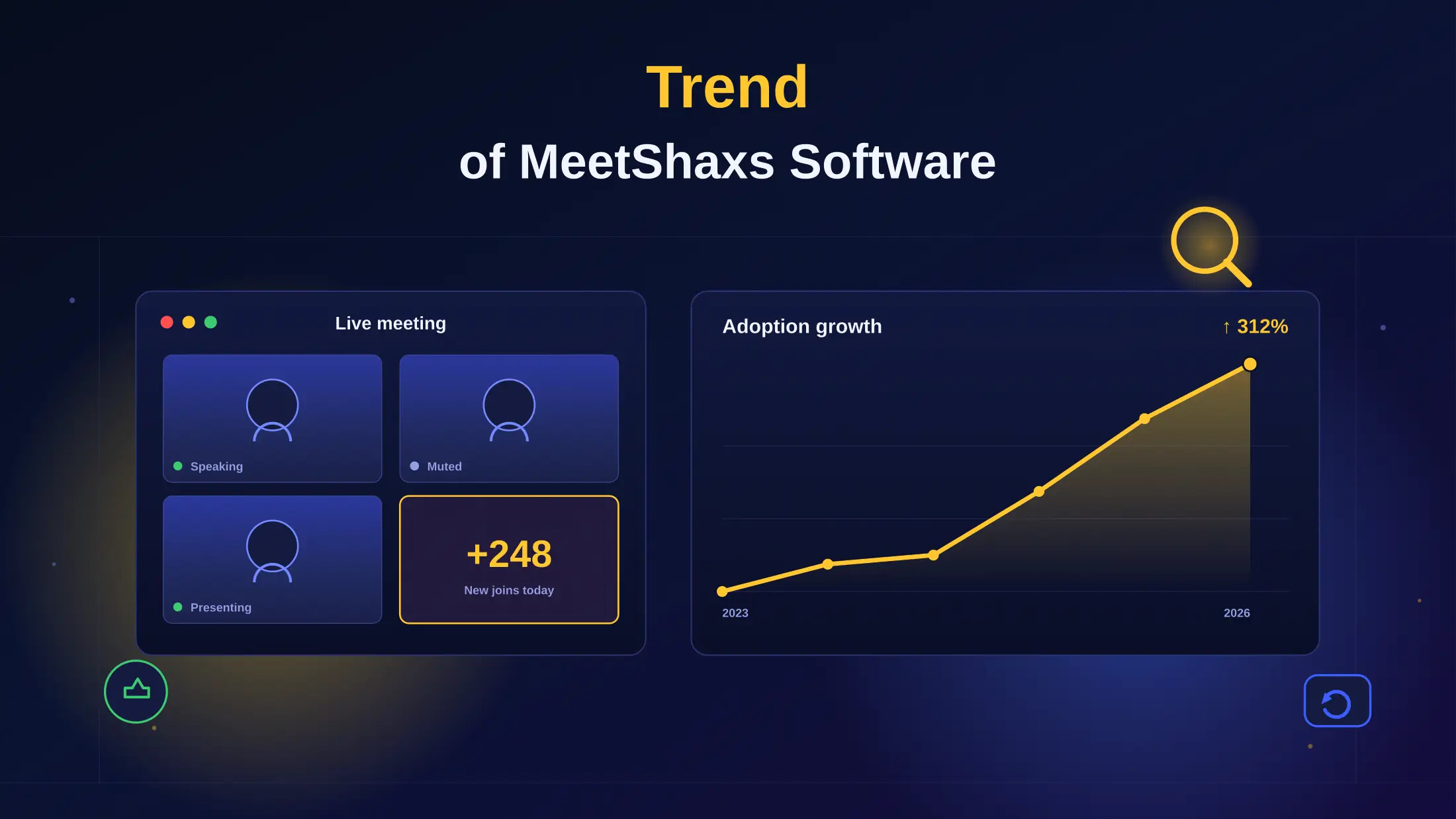

Why the Trend of MeetShaxs Software Is Gaining Attention
The Trend of MeetShaxs Software reflects growing attention from business owners seeking productivity and efficiency without adding another longer to-do list. Companies want software that can save time, cut costs, improve user experience, and support better business decisions.
The wider software market is evolving through digital transformation, creating growing interest in integrated collaboration platforms, digital tools, and software solutions. Remote teams, startups, and enterprises increasingly need team collaboration, workflow integration, and connected workplace systems.
This software trend also creates a need for careful software evaluation. Before adoption, a decision-maker should compare pricing, onboarding time, security, data security, software capabilities, platform features, and business fit against similar tools. This practical tool comparison helps determine whether MeetShaxs can deliver real business productivity value.
What Is MeetShaxs Software?
MeetShaxs is presented online as a software platform connected with productivity, workflow management, collaboration, automation, and business operations. Its public-facing material describes software as a way to streamline work, centralize information, and reduce repetitive processes.
However, MeetShaxs does not have the same level of public documentation and independent coverage as major workplace platforms. That means readers should avoid treating every feature mentioned on third-party websites as a verified product capability.
This is especially important because several websites currently describe MeetShaxs differently. One source characterizes it as a business management and productivity platform, while another describes it as a broader collaboration environment. Other pages make more ambitious claims about AI, integrations, or technical architecture without providing enough independent evidence to confirm those details.
So, what is the safest way to understand it?
Think of MeetShaxs as an emerging software concept associated with modern workplace productivity and collaboration, rather than assuming it already has the market maturity of Microsoft Teams, Slack, Asana, or similar established platforms.
What Can Be Verified About MeetShaxs?
Several broad themes appear repeatedly across publicly available MeetShaxs material:
- Workflow improvement
- Business productivity
- Task and project organization
- Collaboration
- Automation
- Centralized information
- Software performance and improvement
- Technology-driven business operations
The official MeetShaxs site discusses software improvement, productivity, and the broader role of technology in modern work. Its advantages-focused material also describes an integrated environment involving project management, communication, automation, and analytics.
What isn’t equally clear is the independent verification of specific technical capabilities, customer numbers, performance statistics, or adoption rates.
That leads to an important rule:
Treat verified product information as fact and forward-looking claims as claims.
This approach gives readers a much more reliable understanding of an emerging technology platform.
Why Is the Trend of MeetShaxs Software Growing in 2026?
The interest surrounding MeetShaxs makes more sense when viewed against the wider software market.
Businesses are dealing with an unusual combination of pressures. They need greater productivity, but employees already face information overload. They want automation, but poorly designed automation can create more complexity. They want AI, but they also need security, governance, and measurable results.
Microsoft’s 2025 Work Trend Index found that 80% of the global workforce reported lacking enough time or energy to complete their work, while employees were interrupted by meetings, emails, or chats roughly every two minutes during working hours.
That environment creates a strong demand for software that removes friction.
Businesses Want Fewer Disconnected Tools
Many companies use separate applications for communication, project management, documentation, file storage, reporting, scheduling, and customer information.
Each tool may work perfectly on its own. The problem appears between them.
Employees must constantly move information from one system to another. They may copy task details into spreadsheets, send status updates through chat, search several platforms for one document, and then repeat the process later.
This creates context switching.
Integrated software attempts to reduce that problem by bringing related workflows into one environment. MeetShaxs is described in this broader category, with public material emphasizing centralized operations and productivity.
The potential benefit is straightforward:
Fewer disconnected workflows can mean less administrative friction.
That doesn’t automatically make an all-in-one platform better. Specialized tools can outperform broad platforms in specific areas. The real question is whether consolidation improves the user’s workflow.
Remote and Hybrid Teams Need Shared Visibility
Distributed teams create another challenge: information can become fragmented quickly.
One employee may know something because it was discussed in a meeting. Another may only see a related task. A third person might have the relevant document in a different system.
The result is unnecessary meetings and repeated questions.
Atlassian’s 2025 State of Teams research found that teams and leaders spend about 25% of their time searching for answers. Its research covered 12,000 knowledge workers and 200 executives.
That’s a significant productivity problem.
A centralized collaboration platform can potentially help by making information easier to locate and connecting tasks with the people responsible for them.
For MeetShaxs, this is one of the more logical reasons to watch its development. If an emerging platform can genuinely connect work information without adding another layer of complexity, it addresses a real business problem.
Small Businesses Want Automation Without Complexity
Automation used to feel like an enterprise-only concern.
Today, small businesses can automate invoices, customer follow-ups, notifications, reporting, scheduling, task assignments, and other repetitive activities.
The challenge isn’t whether automation exists. It’s whether ordinary teams can configure it without needing a technical specialist.
A useful productivity platform should make automation understandable.
For example, imagine a small agency that receives a new client request. A well-designed workflow could potentially:
- Create a project.
- Assign an initial task.
- Notify the responsible employee.
- Set a deadline.
- Store relevant information.
- Trigger a follow-up reminder.
The value comes from removing repetitive administrative steps.
MeetShaxs-related material repeatedly emphasizes automation and operational efficiency, which aligns with this wider software trend.
AI Is Changing What Users Expect From Software
AI has raised expectations across almost every software category.
People no longer ask only whether an application can store information. They increasingly ask whether it can understand, organize, summarize, predict, or automate parts of their workflow.
Microsoft’s 2026 Work Trend Index describes a workplace increasingly shaped by AI agents and redesigned processes. Its research reports that active agents in the Microsoft 365 ecosystem grew 15 times year over year, illustrating how quickly AI-assisted work is moving into mainstream business environments.
That doesn’t prove that MeetShaxs has equivalent AI capabilities.
It does explain why AI is becoming an important benchmark for newer workplace software.
What Features Should You Look for in MeetShaxs Software?
Feature lists can be misleading when a platform has limited independent documentation. Instead of assuming that every online claim is accurate, evaluate MeetShaxs against the functions a modern business actually needs.
Meeting and Communication Capabilities
If collaboration is central to a platform, communication should be easy to organize and retrieve.
Useful capabilities may include:
- Meeting scheduling
- Shared agendas
- Team communication
- Meeting notes
- Follow-up tasks
- Searchable information
- Notifications
- Cross-team coordination
The important question isn’t how many features appear on a marketing page.
It’s whether those features reduce work.
A meeting application that creates more administrative steps isn’t truly improving productivity.
Task and Project Organization
Task management is another important part of workplace software.
A practical system should make it easy to answer four questions:
- What needs to be done?
- Who owns it?
- When is it due?
- What is its current status?
The simpler those answers become, the easier it is for a team to coordinate.
MeetShaxs-related material describes project and workflow management as part of its broader productivity concept.
Before adopting it, however, businesses should test actual task workflows rather than relying on descriptions alone.
Integrations and Workflow Connectivity
Integrations often determine whether new software fits into an existing technology stack.
A business may already depend on:
- Calendar software
- Cloud storage
- Accounting systems
- CRM platforms
- Project-management tools
- Communication platforms
- Customer support systems
If a new platform cannot connect to essential systems, employees may end up duplicating information.
That’s the opposite of software consolidation.
So, integration depth matters more than the number of features advertised.
User Experience and Accessibility
Good enterprise software doesn’t need to look complicated.
A useful interface should help employees find important functions quickly. New users should understand basic workflows without reading a huge manual.
When evaluating MeetShaxs or any emerging platform, check:
| Evaluation area | What to look for |
| Navigation | Can users find important functions quickly? |
| Onboarding | Can a new employee learn the basics easily? |
| Search | Can users locate information without digging through multiple screens? |
| Mobile access | Can important tasks be handled away from a desktop? |
| Performance | Does the interface remain responsive during normal use? |
| Accessibility | Can different users work comfortably with the interface? |
A polished interface is useful, but usability over several weeks matters more than a good first impression.
Security and Privacy Controls
Security should never become an afterthought.
Business software may contain customer details, financial information, internal documents, employee information, or strategic plans.
Before using an unfamiliar platform, investigate:
- Account security
- User permissions
- Administrative controls
- Data storage
- Privacy practices
- Backup procedures
- Data export options
- Account deletion procedures
- Security documentation
- Third-party access
If a vendor cannot clearly explain how business data is handled, that’s a reason to slow down.
What Makes MeetShaxs Different From Traditional Collaboration Tools?
The potential distinction isn’t simply that MeetShaxs is newer.
The more interesting question is whether it approaches workplace software differently.
Traditional business software often grows feature by feature. A company starts with one core function, then adds messaging, dashboards, integrations, automation, and reporting over time.
That approach can create powerful software.
It can also create clutter.
Emerging platforms have an opportunity to rethink the workflow from the beginning.
All-in-One Software vs Specialized Tools
An integrated platform can offer a cleaner experience when several tasks naturally belong together.
For example, a project might require:
Discussion → Decision → Task → Assignment → Deadline → Progress → Report
If those steps live across six different systems, information can get lost.
An integrated environment can potentially keep that chain together.
However, specialized software still has an advantage when a business needs advanced functionality in one particular area.
A professional accounting department may need specialized financial software. A development team may require sophisticated engineering tools. A marketing team may depend on advanced analytics platforms.
One platform shouldn’t replace every specialized application by default.
Simplicity vs Feature Depth
There is always a trade-off between simplicity and depth.
A simple platform may be easier to learn. A highly configurable platform may handle unusual workflows better.
The right choice depends on the organization.
| Business need | Better priority |
| Small team with simple workflows | Ease of use |
| Large organization | Administration and scalability |
| Specialized operations | Customization |
| Remote team | Collaboration and visibility |
| Cost-conscious business | Consolidation and measurable ROI |
| Highly regulated environment | Security and compliance |
This is where realistic evaluation becomes more useful than hype.
Who Could Benefit From MeetShaxs Software?
The best potential users are teams that have a genuine workflow problem to solve.
Small Businesses and Lean Teams
Small businesses often have limited technical staff.
They need software that employees can manage without constant IT support.
An integrated productivity platform may make sense when a small company is using several disconnected applications for basic operations.
The key metric should be time saved, not the number of features purchased.
Remote and Hybrid Teams
Remote teams benefit from clear digital records.
A well-organized workspace can reduce questions such as:
- Who is handling this?
- What happened during the last meeting?
- Where is the latest document?
- What is waiting for approval?
- What should happen next?
That shared visibility becomes especially valuable when employees work different schedules.
Project-Based Teams
Agencies, consultants, freelancers, and project teams often need a clear connection between conversations and deliverables.
A useful workflow looks like this:
Client request → Internal discussion → Assigned task → Deadline → Review → Completion
The closer software gets to supporting that entire sequence, the less information employees need to transfer manually.
Teams Evaluating Software Consolidation
Businesses paying for several overlapping applications should conduct a software audit.
List every application currently used. Then identify:
- Monthly cost
- Number of active users
- Main purpose
- Overlapping functions
- Integration requirements
- Actual usage
- Problems caused by the tool
Only then should you consider replacing multiple systems with one platform.
When MeetShaxs May Not Be the Best Choice
No software deserves automatic approval.
Emerging platforms can offer interesting ideas while still having limitations.
Limited Documentation Can Make Evaluation Difficult
This is one of the biggest considerations with MeetShaxs.
The public information available online varies significantly between sources. Some pages describe business productivity functions, while others make detailed technical claims that aren’t independently established.
That doesn’t prove those claims are false.
It means buyers should verify them before making business decisions.
Clear documentation is especially important for organizations handling sensitive information.
Smaller Platforms May Have Fewer Integrations
A newer platform may not connect to every application a business already uses.
That can create additional work.
Before switching, make a list of your essential integrations. Don’t assume a popular application is supported simply because another article mentions it.
Switching Software Has Hidden Costs
Software migration isn’t just about subscription prices.
It can require:
- Employee training
- Data migration
- Workflow redesign
- Permission setup
- Documentation
- Testing
- Troubleshooting
- Temporary productivity loss
A platform that costs less but consumes weeks of employee time may not actually save money.
Established Platforms May Offer More Mature Ecosystems
Established software vendors often have advantages in:
- Customer support
- Documentation
- Integrations
- Enterprise administration
- Security resources
- Training materials
- Third-party ecosystems
An emerging platform has to prove that its benefits outweigh those risks.
Is MeetShaxs Software Safe and Legitimate to Use?
Safety is a separate question from usefulness.
A platform can sound innovative and still require careful verification before installation or business adoption.
The public MeetShaxs ecosystem contains several websites and articles using similar terminology. That makes it especially important to distinguish official sources from third-party pages.
Check the Official Source Before Downloading
Never install software from a random pop-up or an unexpected download page.
Instead, verify the publisher and the official distribution channel.
Be cautious when a page:
- Forces an urgent download
- Claims your computer is infected
- Promises an unofficial “premium” version
- Requests unnecessary permissions
- Uses suspicious domains
- Provides unexplained executable files
Fake software updates are a common social-engineering technique because users naturally trust update notifications.
Review Privacy and Data Policies
Before entering business information, ask what happens to that data.
Look for clear answers about:
- Data collection
- Data retention
- Data sharing
- Third-party processors
- Account deletion
- Data export
- Security controls
If those answers aren’t available, don’t assume the best-case scenario.
Watch for Fake Updates and Impersonation
The more attention a software name receives, the more attractive it can become for impersonators.
A legitimate update should come through a trusted software channel.
Don’t click an unexpected update link simply because it contains the correct product name.
Verify Claims Before Paying
Before purchasing a subscription, confirm:
- The actual price
- Billing frequency
- Available plans
- Trial terms
- Refund policy
- User limits
- Storage limits
- Support availability
- Cancellation process
A screenshot or third-party article isn’t enough.
Verify the commercial terms at the point of purchase.
How to Evaluate MeetShaxs Before Adopting It
A structured test is much more useful than simply asking whether the software looks impressive.
Define Your Team’s Actual Problem
Start with the problem.
Don’t start with the software.
For example:
“Our team spends six hours every week preparing project reports.”
That’s measurable.
“ We need better productivity software” isn’t.
Once you know the problem, you can test whether the platform actually solves it.
Compare Required Features With Verified Features
Create two lists.
Must-have features
- Task management
- User permissions
- Reporting
- Required integrations
- Data export
- Collaboration
- Security controls
Nice-to-have features
- AI assistance
- Advanced dashboards
- Extra automation
- Custom layouts
- Additional integrations
This prevents flashy features from distracting you from essential requirements.
Run a Small Pilot
Don’t migrate the entire company immediately.
Choose one department or project.
A practical pilot might last several weeks and measure:
| Metric | Before adoption | After pilot |
| Weekly reporting time | Record baseline | Compare |
| Manual data entry | Record baseline | Compare |
| Tool-switching frequency | Record baseline | Compare |
| Task completion time | Record baseline | Compare |
| Employee adoption | Record baseline | Compare |
| Software cost | Record baseline | Compare |
The goal isn’t to prove that MeetShaxs works.
The goal is to find out whether it works for your organization.
Measure the Results
A useful ROI calculation doesn’t need to be complicated.
Suppose a team saves five hours per week through better workflow management.
If the blended labor value of those hours is $30 per hour, the recovered time represents approximately:
5 × $30 × 52 = $7,800 per year
That’s not guaranteed savings. It’s a simple model showing why time measurement matters.
If the software costs $1,500 annually and genuinely creates that level of recovered capacity, the business has a stronger case.
If nobody uses the platform after three months, the subscription isn’t the only problem.
MeetShaxs vs Traditional Collaboration Software
The right comparison isn’t “new versus old.”
It’s fit versus requirements.
| Factor | MeetShaxs | Established collaboration platforms |
| Market maturity | Emerging and less clearly documented | Generally mature |
| Workflow approach | Positioned around integrated productivity | Varies by platform |
| Integrations | Verify individually | Often broader ecosystems |
| Documentation | Public information varies | Usually extensive |
| Support ecosystem | Verify before adoption | Typically more established |
| Innovation potential | Potentially high | Depends on vendor |
| Migration risk | Requires careful testing | Usually lower for established tools |
| Best evaluation method | Pilot and verify | Compare plans and capabilities |
This comparison also highlights why blanket claims are risky.
MeetShaxs doesn’t need to be “better than everything” to be useful. It only needs to solve a particular team’s problems more effectively than its current setup.
What the Trend of MeetShaxs Software Says About the Software Market
The bigger story is much broader than one software name.
Modern businesses are moving toward connected systems of work.
Information is becoming more valuable when employees can find and act on it quickly. Atlassian’s research found that teams spend roughly one-quarter of their time searching for answers, while 93% of surveyed executives said cross-functional collaboration has become more important.
That creates a powerful market incentive.
Software companies increasingly need to solve the spaces between tasks.
The future workplace isn’t simply about having more applications. It is about making those applications, people, data, and AI systems work together.
That is also why AI has become so important.
Microsoft’s 2026 research argues that organizations need to redesign work processes as AI agents take on more execution. The emphasis is shifting from merely adding AI features toward deciding how humans and digital agents should collaborate.
For emerging productivity platforms, that creates both an opportunity and a challenge.
A new tool can experiment with better workflows from the beginning.
But users will expect proof.
What Could Change Next for MeetShaxs Software?
Future developments should be treated as possibilities rather than confirmed product roadmaps unless the company publishes them officially.
Deeper AI Integration
AI could make workplace software more proactive.
Instead of simply recording information, future systems may help identify:
- Missing tasks
- Repeated workflow problems
- Upcoming deadlines
- Information gaps
- Unresolved decisions
- Bottlenecks
- Routine processes suitable for automation
Microsoft’s 2026 Work Trend Index reflects this broader shift toward AI agents that execute work while humans provide direction, judgment, and accountability.
For MeetShaxs, deeper AI functionality could become important if the platform wants to compete in the modern productivity market.
Greater Platform Integration
Users increasingly expect software to connect rather than operate in isolation.
Future collaboration tools will likely need stronger connections between:
Communication + Tasks + Documents + Data + AI + Business Workflows
That integration could become more important than adding another standalone feature.
Stronger Focus on Security and Data Control
As software becomes more connected, security becomes more complicated.
AI systems may access documents. Automation may trigger business processes. Integrations may move data between platforms.
That creates new risks.
The strongest platforms will need to make permissions, data usage, monitoring, and administrative controls easy to understand.
More Pressure to Prove Business Value
The software market is becoming less tolerant of expensive tools that produce vague productivity promises.
Businesses increasingly want measurable outcomes.
They want to know:
- How much time did the tool save?
- How many manual steps disappeared?
- Did adoption improve?
- Did errors decrease?
- Did employees actually use it?
- Did the subscription replace other costs?
That shift will favor software companies that can demonstrate results rather than simply advertise features.
How to Decide Whether MeetShaxs Is Worth Trying
There isn’t one correct answer for every business.
MeetShaxs may be worth investigating if your team has fragmented workflows, unnecessary tool switching, repetitive administrative work, or a genuine need for centralized productivity management.
However, the decision should depend on evidence.
Use this quick evaluation checklist:
- Identify the problem first.
- Verify every important feature.
- Check integrations before migrating.
- Review privacy and security information.
- Confirm current pricing and terms.
- Test the platform with a small group.
- Measure productivity before and after adoption.
- Ask employees whether the workflow actually feels easier.
- Keep an exit plan if the platform doesn’t meet expectations.
This approach protects your business from both hype and unnecessary switching costs.
Frequently Asked Questions About MeetShaxs Software
Q1.What is MeetShaxs software?
MeetShaxs is discussed as an emerging software platform connected with productivity, collaboration, and business workflows. Its exact capabilities should be checked against current and reliable product information before adoption.
Q2.Why is MeetShaxs software gaining attention?
Growing interest in connected collaboration tools, automation, and workplace productivity is helping newer software platforms attract attention. Businesses also want to reduce the number of disconnected tools they use.
Q3.Who can benefit from MeetShaxs software?
Small businesses, remote teams, startups, project groups, and organizations reviewing their software stack may find it worth evaluating. The right choice depends on specific workflow needs and available features.
Q4.Is MeetShaxs software safe to use?
Users should verify the official software source, privacy policy, security controls, and data-handling practices before using it. Avoid downloading software from suspicious third-party pages or unexpected update prompts.
Q5.How should businesses evaluate MeetShaxs?
Start by identifying the problem you want to solve. Then compare features, pricing, integrations, security, onboarding, usability, and measurable productivity results with your existing tools.
Q6.Is MeetShaxs better than other collaboration software?
Not necessarily. Established platforms may offer stronger ecosystems and wider integrations, while an emerging platform may suit certain workflows better. Compare the tools based on your team’s actual requirements.
Q7.What is the future of MeetShaxs software?
Its future will depend on product development, user adoption, reliability, integrations, security, and measurable business value. Broader software trends suggest that AI, automation, and connected workflows will remain important.
Conclusion
The Trend of MeetShaxs Software reflects a wider move toward connected workplace technology, simpler workflows, and better productivity. Businesses are looking for tools that can reduce repetitive work, improve collaboration, and keep important information easier to manage. However, interest alone doesn’t prove that a software platform is the right choice for every team. Before adopting MeetShaxs, check its current features, pricing, security, integrations, onboarding process, and overall business fit. A small test can also help you see whether the platform actually saves time and improves daily work. The smartest approach is simple: verify the facts, compare similar tools, measure real results, and choose software that solves a clear business problem.
