
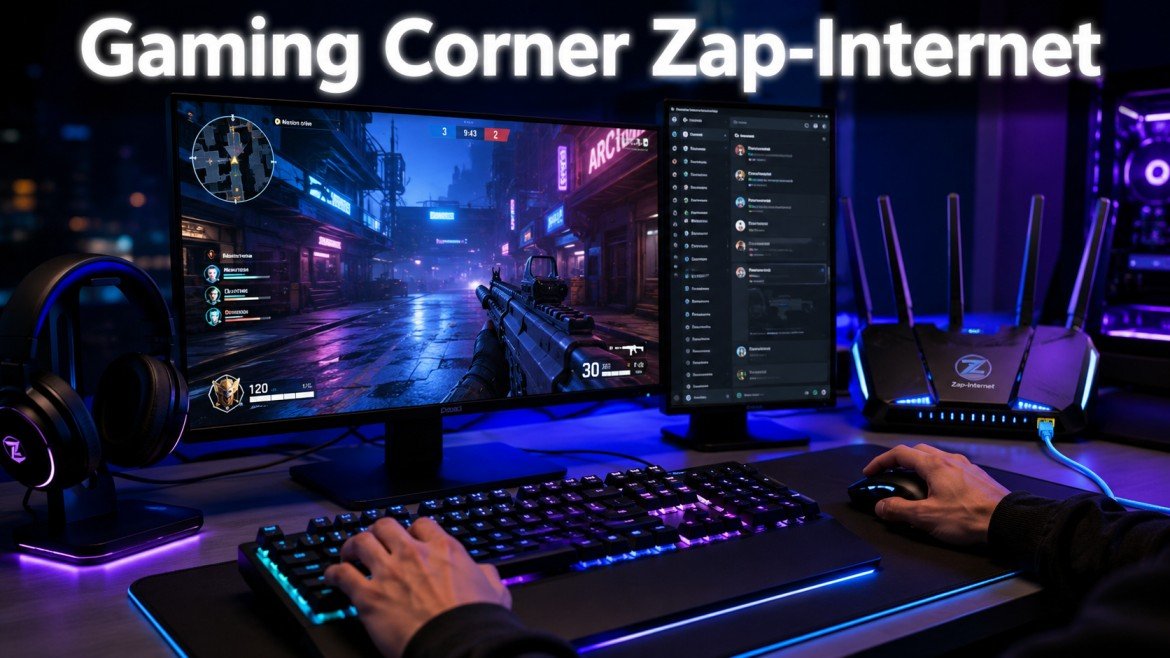

Gaming Corner Zap-Internet has become a popular topic among gamers looking to fix one problem: lag. If you’ve ever wondered whether this setup is worth the switch from your regular internet plan, you’re not alone. This guide breaks down exactly what it does, how it compares to standard broadband, and whether it fits your gaming style.
At its core, Zap-Internet focuses on low latency, stable ping, and smart traffic prioritization — the three things that actually control how smooth your games feel. Speed alone doesn’t stop lag, and this article explains why, using real ping benchmarks and simple comparisons anyone can understand.
You’ll also find a breakdown of pricing plans, home setup tips, common troubleshooting fixes for issues like packet loss and jitter, and whether this setup works well for cloud gaming and mobile play. By the end, you’ll know exactly who this internet setup is built for — and who can skip it.
Quick Answer: Gaming Corner Zap-Internet is a gaming-focused internet setup that combines high-speed bandwidth, low-latency routing, and gaming-ready hardware to reduce lag during online play. It’s built for gamers who need stable ping, fast reaction times, and consistent connections — but it’s most worth it for competitive and streaming setups, not casual weekend gamers.
What Is Gaming Corner Zap-Internet?
Gaming Corner Zap-Internet is an internet and hardware combo designed specifically for gaming performance, not just general browsing or streaming Netflix.
It focuses on three things regular broadband usually ignores: low latency, traffic prioritization, and stable connections during peak hours. Instead of just promising fast download speeds, it’s built around what actually affects gameplay — things like ping spikes, jitter, and packet loss.
Here’s who it’s built for:
- Competitive gamers who play ranked matches
- Streamers who need a stable upload during live sessions
- Households with multiple gamers online at once
- Anyone tired of random lag spikes during matches
In simple terms, Zap-Internet treats gaming traffic differently than a normal internet connection. It prioritizes your game data over background downloads, updates, or other devices eating up bandwidth.
Why Lag Happens (And Why Regular Internet Doesn’t Fix It)
Most people think a faster internet plan will fix lag. It usually doesn’t. Lag is rarely about speed alone — it’s about how fast and how consistently your data travels back and forth.
Speed vs. Ping vs. Latency — What Actually Matters
These three terms get mixed up constantly, but they mean different things:
| Term | What It Measures | Why It Matters for Gaming |
| Speed (Bandwidth) | How much data you can download or upload | Affects load times, downloads, streaming quality |
| Ping | The round-trip time for data to reach a server and come back | Directly affects how “instant” your actions feel in-game |
| Latency | The delay before data transfer starts | Causes the lag between pressing a button and seeing it happen |
You can have a 500 Mbps plan and still lag badly if your ping is high. That’s the part most regular broadband plans don’t fix.
Example: Imagine two players in the same ranked match. Player A has a 300 Mbps connection with 90ms ping. Player B has a 100 Mbps connection with 15ms ping. Player B will feel far more responsive, even with a third of the bandwidth, because their actions reach the game server almost instantly.
Good Ping Numbers for Competitive Gaming
Here’s a general benchmark for what counts as good, playable, or bad ping in most competitive games:
- Under 20ms – Excellent, near-instant response
- 20–50ms – Good, ideal for competitive play
- 50–100ms – Playable, but noticeable delay
- 100ms+ – Frustrating lag, hard to compete at a high level
If you’re playing fast-paced shooters or fighting games, anything above 50ms starts to feel sluggish.
Why More Bandwidth Doesn’t Mean Less Lag
This is the part most people get wrong. Bandwidth is like the width of a highway — it controls how much data moves at once. Ping and latency are more like how fast the cars actually travel.
You can widen the highway all you want (more bandwidth), but if there’s a slow route or extra stops along the way (high latency), your data still arrives late. That’s why upgrading to a faster plan doesn’t always fix lag — it just moves more data slowly instead of a little data quickly.
Core Features That Set Zap-Internet Apart
Gaming Corner Zap-Internet isn’t just a marketing label for regular broadband. It bundles a few specific features that target gaming performance directly.
Speed and Bandwidth
It still delivers strong download and upload speeds, which matter for game downloads, updates, and streaming. But speed here supports the setup — it’s not the main selling point.
Low-Latency Routing and QoS
This is the core feature. QoS (Quality of Service) routing prioritizes gaming traffic over things like background downloads, smart TVs, or other devices on the same network. Your game gets first access to bandwidth, which helps keep ping low even when other devices are active.
Gaming-Ready Hardware
Setups often include gaming-grade routers and, in physical gaming venues, high-performance stations. These handle more simultaneous connections without slowing down, unlike basic consumer routers.
Standard consumer routers are built for general browsing, so they often struggle once you add gaming, streaming, and smart home devices to the same network. Gaming-grade hardware is designed to handle that load without dropping performance.
Cross-Device and Cross-Platform Support
Whether you’re on PC, console, or mobile, the setup is built to keep performance consistent across devices. This matters for households where multiple people game on different platforms at once.
Network Stability During Peak Hours
Evenings and weekends are when most networks slow down, since that’s when the most people are streaming, gaming, and downloading at once. Zap-Internet’s traffic prioritization is built to hold up during these peak windows instead of slowing down like a typical shared connection.
This matters most in shared households, where someone streaming a 4K show shouldn’t be able to spike your ping mid-match.
Gaming Corner Zap-Internet vs. Regular Broadband
Here’s a direct side-by-side comparison, since this is the part most people actually want to know before deciding.
| Feature | Gaming Corner Zap-Internet | Regular Broadband |
| Latency Focus | Prioritized and optimized | Not prioritized |
| Traffic Routing (QoS) | Built-in gaming priority | Rarely included or configured |
| Hardware | Gaming-grade routers/stations | Standard consumer router |
| Multi-Device Handling | Optimized for simultaneous gaming | Can slow down under load |
| Pricing | Higher, gaming-specific plans | Lower, general-use plans |
| Best For | Competitive and streaming setups | Everyday browsing and streaming |
The key difference isn’t raw speed — it’s consistency. Regular broadband can be fast on paper but unpredictable during peak hours. Zap-Internet is built to stay consistent, even when the network is busy.
Pricing Plans: Which One Fits Your Setup
Pricing typically scales based on how serious your gaming needs are. Here’s a general breakdown by user type:
Casual Gamer
- Lower-tier plan
- Good for solo or occasional online play
- Basic QoS prioritization included
Competitive Gamer
- Mid-tier plan
- Lower ping targets and stronger traffic prioritization
- Recommended for ranked or tournament play
Streamer / Content Creator
- Higher-tier plan
- Prioritizes upload speed alongside low ping
- Built to handle simultaneous streaming and gaming
Choosing the right plan comes down to what you actually do online. A casual gamer doesn’t need the same setup as someone streaming ranked matches five nights a week.
How to Set It Up at Home for the Best Results
Even with a strong plan, your home setup affects performance. Follow these steps to get the most out of it:
- Use a Wired Ethernet Connection – Wi-Fi introduces extra latency. A wired connection is the single biggest fix for lag.
- Turn On QoS in Your Router – This prioritizes gaming traffic over other devices using your network.
- Place Your Router the Right Way – Keep it central, elevated, and away from walls or metal objects that block signal.
- Close Background Apps and Downloads – Updates, cloud backups, and streaming apps eat bandwidth and increase ping.
- Update Your Router Firmware – Outdated firmware can cause slowdowns and security gaps.
- Lock Down Your Network Security – An unsecured network means strangers could be using your bandwidth without you knowing.
- Consider Wi-Fi 6 or Wi-Fi 7 – If wired isn’t possible, newer Wi-Fi standards handle multiple devices with far less lag than older routers.
Still Lagging? Common Problems and Fixes
Even with a good setup, lag can still happen. Here are the usual culprits:
Packet Loss Small chunks of data fail to arrive, causing stutters or rubber-banding. Usually caused by a weak signal, faulty cable, or network congestion.
Jitter Ping that constantly fluctuates instead of staying steady. Often caused by unstable connections or too many devices competing for bandwidth.
ISP Throttling Some internet providers slow down gaming or streaming traffic during peak hours. A wired connection and QoS settings can help, but this ultimately depends on your provider.
Router Overheating Routers running for weeks without a restart can overheat and slow down. A simple restart every week or two prevents this.
Quick Fixes to Try First:
- Restart your router and modem
- Switch to a wired connection
- Check for background downloads or updates
- Move closer to the router if using Wi-Fi
- Contact your ISP if the issue persists across multiple devices
Example: If your ping suddenly jumps from 25ms to 150ms mid-match, that’s a latency spike, not a bandwidth problem. Check if someone else on your network started a large download or a video call — that’s the most common cause. If the spike happens with no other devices active, the issue is likely on your ISP’s end, not your home setup.
A simple way to tell the difference: run a ping test while your network is idle, then again while another device is streaming or downloading. A big jump between the two confirms the issue is local, not with your provider.
Does It Work for Cloud Gaming and Mobile Play?
Yes, and this matters more every year as cloud gaming grows. Services like GeForce Now and Xbox Cloud Gaming rely heavily on low latency, since the actual game runs on a remote server, not your device.
For cloud gaming specifically, ping matters even more than usual, since every input has to travel to the server and back before you see it happen. A setup like Zap-Internet that prioritizes low latency is a strong match for this kind of gaming.
Mobile esports and competitive mobile games benefit too, especially over Wi-Fi, since mobile connections are more prone to jitter and instability than wired setups.
Most cloud gaming platforms recommend a stable connection with ping under 40–60ms for a smooth experience. Above that range, input delay becomes noticeable, even if your download speed easily meets the platform’s minimum requirement. This is exactly why a latency-focused setup like Zap-Internet fits cloud gaming better than a standard high-speed plan that doesn’t prioritize traffic.
The Community Side: Tournaments and Team Play
Gaming Corner Zap-Internet isn’t just about the technical setup — it also connects to a broader gaming community for players who want more than solo matches.
Monthly Tournaments
Regular tournaments give competitive players a reason to test their setup under real pressure, not just casual matches. These events often bring together players across different skill levels and games.
Strategy Sharing and Squad Building
Beyond tournaments, the community side includes spaces for players to share strategies, find teammates, and build squads for ranked play. This matters for gamers who want consistent teammates instead of random matchmaking.
Who Should Use Gaming Corner Zap-Internet?
Not everyone needs this level of setup. Here’s a quick breakdown:
Casual Gamers Might not need the full setup, but can benefit from basic QoS and a wired connection.
Competitive Gamers This is where the setup makes the biggest difference — lower ping and consistent connections directly affect performance.
Streamers and Content Creators The upload prioritization and stability make a noticeable difference during live streams.
Families with Multiple Gamers Multi-device handling prevents one person’s download from lagging out someone else’s match.
Here’s a quick way to decide if it’s worth it for you:
| Your Situation | Worth It? |
| Play ranked or competitive matches regularly | Yes — low ping directly improves performance |
| Stream or create content while gaming | Yes — upload prioritization keeps streams stable |
| Multiple gamers in the same household | Yes — prevents one device from lagging out another |
| Play casually a few times a week | Maybe — basic QoS and a wired connection may be enough |
| Only play single-player or offline games | No — latency optimization won’t make a difference |
Frequently Asked Questions
What is Gaming Corner Zap-Internet?
Gaming Corner Zap-Internet is a gaming-focused internet setup that combines high-speed bandwidth, low-latency routing, and QoS traffic prioritization to reduce lag and keep online gameplay smooth and consistent.
What ping is good for competitive gaming?
A ping under 20ms is excellent, while 20–50ms is considered good for most competitive games. Anything above 100ms usually causes noticeable lag and slower reaction times.
Does bandwidth alone fix lag?
No. Bandwidth controls how much data you can move, but ping and latency control how fast that data travels. A high-bandwidth plan can still lag if latency isn’t managed properly.
Can I use it for cloud gaming and mobile?
Yes. Zap-Internet’s low-latency focus works well for cloud gaming platforms like GeForce Now and Xbox Cloud Gaming, along with mobile esports, where ping affects performance even more than on PC or console.
What causes packet loss during online play?
Packet loss usually comes from a weak signal, faulty cabling, network congestion, or too many devices competing for bandwidth at once. It often shows up as stuttering or rubber-banding in games.
Is it beginner-friendly?
Yes. Casual gamers can benefit from basic features like QoS prioritization and a wired connection, even without needing the full competitive-level setup.
How much does it cost per month?
Pricing depends on your plan tier — casual, competitive, or streamer-focused. Competitive and streaming plans cost more since they include stronger latency optimization and upload prioritization.
Final Thoughts
Gaming Corner Zap-Internet isn’t just faster internet — it’s internet built around what actually causes lag: ping, latency, and traffic prioritization. Regular broadband can hit high speed numbers on paper, but it rarely stays consistent when it matters most, like during a ranked match or live stream.
If you’re a competitive gamer or content creator, this setup solves real problems regular plans can’t touch. Casual gamers can still benefit from a few key changes, like a wired connection and QoS settings, without needing the full package.
The bottom line: match the plan to how you actually play. Once your ping stays low and your connection stays stable, lag stops being the reason you lose.
