
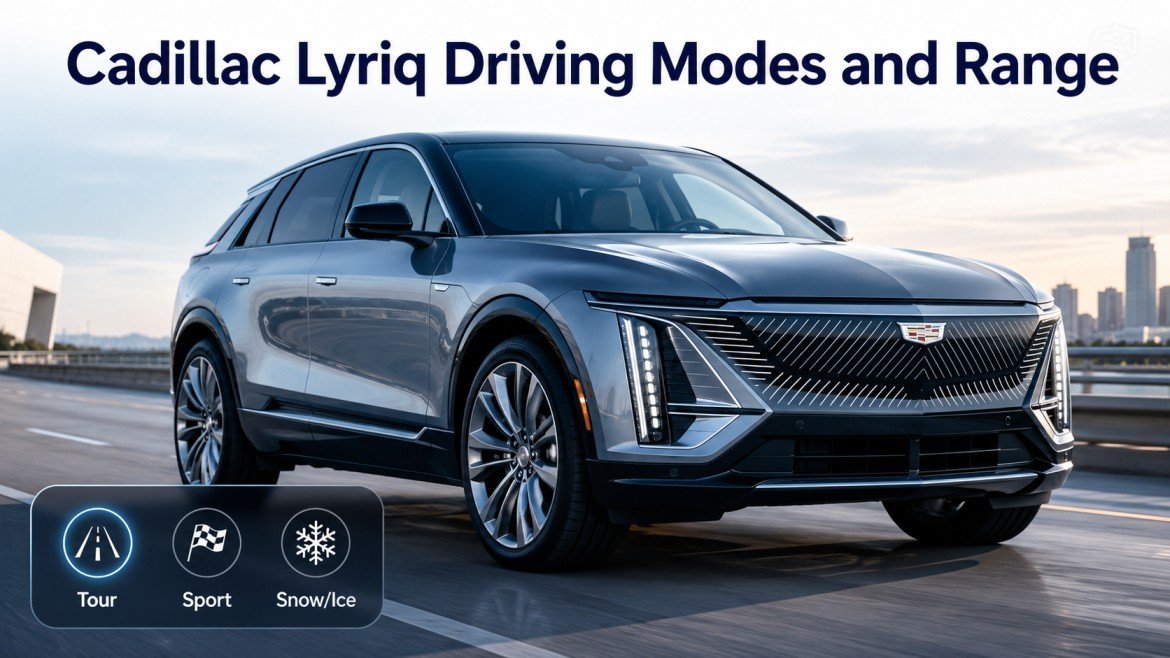

Do driving modes in the Cadillac Lyriq offer different ranges or battery usage? It’s one of the first questions new owners ask once they notice the mode selector on the dash. Switching between settings clearly changes how the SUV feels, but many drivers wonder if it also changes how far they can go on a single charge.
The short answer is yes, though not in the way most people expect. Driving modes don’t touch the size of the battery pack itself. What they do change is how quickly that stored energy gets used.
This guide breaks down exactly how each Cadillac Lyriq driving mode affects battery consumption, why real-world range can differ from EPA estimates, and what actually influences efficiency beyond mode selection alone.
Quick Answer
Yes, driving modes in the Cadillac Lyriq affect range and battery usage, but they don’t change battery capacity. Each mode adjusts throttle response, motor output, and regenerative braking strength, which changes how efficiently energy is consumed per mile. The battery stays the same size in every mode; only the rate of consumption shifts.
How Driving Modes Affect Range and Battery Usage in EVs (General Explanation)
A driving mode in an electric vehicle is essentially a software profile. It doesn’t add or remove physical hardware. Instead, it adjusts how existing systems respond to driver input.
Switching modes typically changes:
- Throttle mapping – how aggressively power is delivered when you press the accelerator
- Motor output – how much instantaneous torque the motor sends to the wheels
- Regenerative braking calibration – how much energy is captured during deceleration
- Climate system priority – how much energy heating or cooling is allowed to draw in certain settings
The key distinction to understand is this: battery capacity is fixed, but energy consumption is variable. The Lyriq’s battery holds a set amount of stored energy regardless of which mode is active. What changes is how fast that energy gets drawn down, which directly affects how many miles you get per charge.
Cadillac Lyriq Driving Modes Explained
Tour Mode: Balanced Efficiency for Everyday Driving
Tour Mode is the Lyriq’s default, balanced setting. Throttle response is smooth and gradual rather than sharp, which reduces sudden spikes in energy draw. This mode is built for daily commuting and highway cruising, where steady, predictable acceleration matters more than quick bursts of power.
Because Tour Mode avoids aggressive power delivery, it typically produces the closest real-world results to the Lyriq’s EPA-estimated range, especially under moderate weather and normal driving conditions.
Sport Mode: Stronger Performance, Higher Consumption
Sport Mode sharpens throttle response significantly. Acceleration feels quicker and more immediate, which makes the SUV more engaging to drive but increases how much energy the motor pulls from the battery in short bursts.
Regenerative braking is also typically softened in this mode to preserve a sportier driving feel. The combination of sharper acceleration and lighter regen means Sport Mode consistently reduces range compared to Tour Mode, particularly with frequent hard acceleration.
Snow/Ice Mode: Traction and Control Over Efficiency
Snow/Ice Mode isn’t built around efficiency or performance. Its priority is traction control on slippery surfaces. Throttle input is softened to prevent wheel slip, and the system intervenes more readily to keep the vehicle stable.
Energy usage in this mode sits between Tour and Sport, though cold weather itself often plays a bigger role in reduced range than the mode setting does. Battery chemistry naturally performs less efficiently in low temperatures, independent of which mode you select.
My Mode: Custom Settings and How It Affects Range
My Mode lets drivers customize throttle sensitivity, steering weight, and regenerative braking strength individually. Its effect on range depends entirely on how it’s configured.
A driver who sets softer throttle response and stronger regen can approximate Tour Mode’s efficiency. A driver who tunes it closer to Sport Mode’s responsiveness will see similar consumption patterns to that mode instead.
Driving Modes and Range: Side-by-Side Comparison
| Mode | Power Delivery | Regen Braking Behavior | Typical Range Impact |
| Tour | Smooth, gradual | Balanced, moderate capture | Closest to EPA estimate |
| Sport | Sharp, immediate | Reduced, lighter feel | Noticeably lower range |
| Snow/Ice | Softened for traction | Moderate, stability-focused | Slightly reduced, weather-dependent |
| My Mode | Fully customizable | Adjustable by driver | Varies based on settings chosen |
The takeaway here is straightforward: modes built around smooth, gradual power delivery and stronger regenerative braking consistently produce better real-world range than modes tuned for quick acceleration.
Why Range Changes Even Though Battery Capacity Doesn’t
This is the core concept that clears up most of the confusion. Battery capacity refers to the total stored energy available, measured in kilowatt-hours. That number is fixed the moment you buy the vehicle and doesn’t shift based on mode selection.
Energy consumption, on the other hand, is dynamic. It depends on how much power the motor demands per mile, which is directly shaped by throttle mapping and acceleration behavior. A mode that draws power aggressively burns through the same battery faster than one that delivers power smoothly, even though both modes start with an identical charge.
Regenerative Braking Across Different Modes
Regenerative braking captures kinetic energy during deceleration and sends it back into the battery instead of losing it as heat through traditional friction brakes. It plays a meaningful role in how far an EV travels on a single charge.
Regen strength shifts by mode:
- Efficiency-focused modes like Tour tend to maximize regen capture
- Performance modes like Sport often soften regen to preserve a natural braking feel
- Snow/Ice Mode balances regen with stability, since aggressive regen can affect traction on slick surfaces
Frequent stop-and-go driving, particularly in city traffic, gives regenerative braking more opportunities to recover energy, which can partially offset the range cost of less efficient driving habits.
Real-World Range vs. EPA Estimated Range in the Lyriq
The Cadillac Lyriq carries an EPA-estimated range generated under controlled testing conditions designed to represent typical driving. In practice, real-world range rarely matches that figure exactly.
Several factors widen the gap:
- Highway driving at sustained higher speeds increases energy demand
- Cold weather reduces battery efficiency and increases heating system use
- Hot weather increases air conditioning load
- Aggressive acceleration patterns raise consumption regardless of mode
Two drivers in the same Lyriq, driving the same route, can see meaningfully different range results depending on mode selection and driving behavior alone.
Other Factors That Affect Range Besides Driving Mode
Driving mode is only one piece of the range equation. Several other factors carry just as much weight, sometimes more.
Climate control and cabin heating/cooling Heating the cabin in cold weather draws substantial energy, often more than the difference between driving modes. Air conditioning has a similar, though usually smaller, effect.
Highway speed vs. city driving Sustained high speeds increase aerodynamic drag significantly, which raises consumption regardless of mode. City driving with frequent regen opportunities can sometimes be more efficient than steady highway cruising.
Tire pressure and vehicle load Underinflated tires increase rolling resistance, while extra passenger or cargo weight raises the energy needed to move the vehicle.
Cold weather battery behavior Battery chemistry itself becomes less efficient in low temperatures, independent of mode. This affects both available range and charging speed.
Tips to Maximize Range and Battery Efficiency in the Lyriq
- Precondition the battery and cabin while still plugged in, especially in cold weather, to avoid drawing that energy from the battery once driving starts
- Match mode to trip type — Tour Mode for daily commuting and long trips, Sport Mode reserved for short bursts where performance matters more than range
- Lean into regenerative braking by anticipating stops early instead of braking hard at the last moment
- Maintain proper tire pressure to reduce rolling resistance
- Limit unnecessary climate control use by relying on seat heating or targeted airflow instead of full cabin heating when possible
Which Driving Mode Should You Use for Daily Driving vs Long Trips
For daily commuting, Tour Mode is generally the strongest choice. It balances comfort with efficiency and keeps real-world range closest to the EPA estimate.
For long-distance trips where range matters most, sticking with Tour Mode and maintaining steady highway speeds produces the most predictable results. Reserve Sport Mode for situations where quick acceleration matters more than maximizing distance, such as merging or short recreational drives. Snow/Ice Mode should be used specifically when road conditions call for it, regardless of its effect on range, since safety takes priority in those situations.
FAQs
Do driving modes in the Cadillac Lyriq really change its range?
Yes, though only indirectly — each mode changes how quickly stored energy is used, not how much energy the battery holds.
Which Lyriq driving mode is best for daily commuting?
Tour Mode, since its smooth throttle response and stronger regen typically deliver the most predictable everyday mileage.
Does Sport mode always drain the battery faster?
In most cases yes, especially with frequent hard acceleration, though gentle driving in Sport Mode narrows the gap somewhat.
Can driving mode selection improve overall efficiency?
Yes, choosing a mode that matches your driving style, paired with smoother habits, meaningfully improves miles per charge.
Is regenerative braking active in every driving mode?
Yes, but its strength and feel differ, with efficiency-focused modes generally capturing more energy than performance-oriented ones.
Does cold weather affect range more than driving mode does?
Often yes, since battery chemistry itself loses efficiency in low temperatures regardless of which mode is selected.
How much real-world range difference can I expect between modes?
It varies by driving style and conditions, but Sport Mode typically shows a noticeably larger drop than Tour or Snow/Ice Mode.
Final Thoughts
So, do driving modes in the Cadillac Lyriq offer different ranges or battery usage? The evidence points to a clear yes, just not through changing the battery itself. Every mode works with the same fixed energy supply; what shifts is how efficiently that energy gets spent mile after mile.
Tour Mode rewards patient, steady drivers with the closest results to the EPA figure. Sport Mode trades some of that mileage for a livelier feel behind the wheel. Snow/Ice Mode prioritizes control when the road demands it, and My Mode puts the entire balance in the driver’s hands.
At the end of the day, mode selection is one lever among several. Combine it with smart habits like preconditioning, steady acceleration, and mindful climate use, and the Lyriq becomes a genuinely efficient companion for both short commutes and long stretches of highway.
