
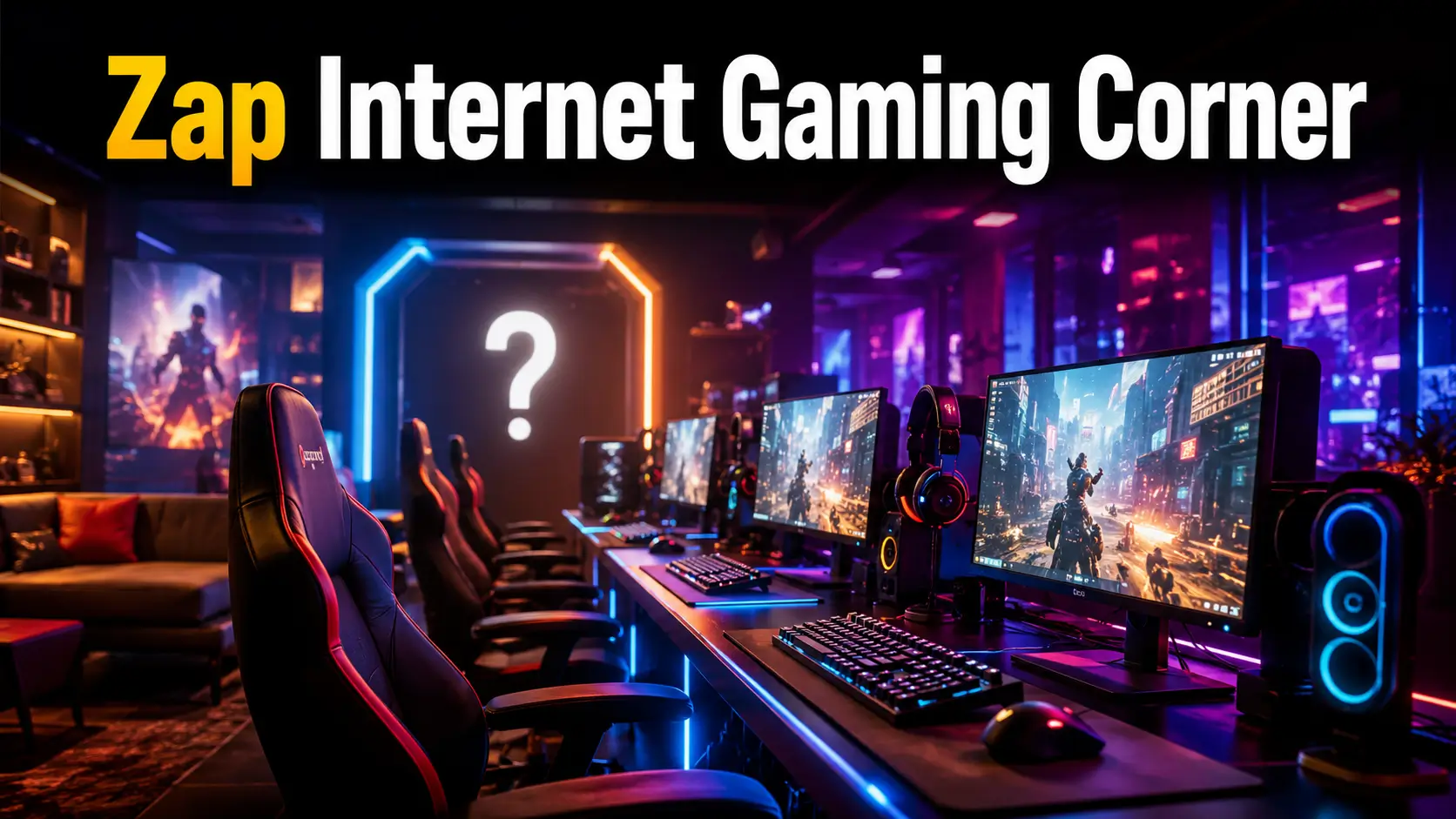

How Zap Internet Gaming Corner Creates a Better Gaming Environment
Zap Internet Gaming Corner brings gaming, internet connectivity, and a focused gaming environment together for smoother play, whether you’re a casual player or competitive gamer.
A useful gaming space needs more than fast internet. Good hardware, gaming equipment, a stable connection, and strong network stability can reduce lag, while low latency, low jitter, and less packet loss help keep online matches responsive. Players should also check the gaming setup, available PC gaming or console gaming, and whether the game server is nearby.
For a first-time visitor, simple practical tips can help: test the connection, check the network performance, confirm the gaming requirements, and protect your account. A comfortable physical setup, reliable gaming network, and positive community vibe can make the gaming experience better without relying on speed alone.
What Is Zap Internet Gaming Corner?
A gaming corner is a dedicated space designed for playing video games, especially games that benefit from reliable internet access, capable hardware, and multiplayer interaction.
Unlike a basic internet café, a gaming-focused space is built around the needs of players. Depending on the location, it may provide gaming PCs, consoles, monitors, keyboards, mice, controllers, headsets, and access to online multiplayer games.
The exact setup matters. A gaming corner with modern gaming PCs and high-refresh-rate monitors offers a different experience from a small space with basic computers.
The same applies to the internet connection. A high-speed connection can help with downloads and updates, but speed isn’t the only measurement that matters during a game.
Players should also consider:
- Latency: How long data takes to travel between the device and game server.
- Jitter: How much latency changes over time.
- Packet loss: Data packets that fail to reach their destination.
- Connection stability: Whether the connection stays consistent during a session.
- Network congestion: How much other traffic is competing for bandwidth.
A good gaming environment brings these factors together rather than focusing on only one number.
What Makes a Gaming Corner Different From Gaming at Home?
Home gaming gives you control over your equipment and network. A gaming corner offers convenience and shared access to gaming resources.
At home, a player might need to purchase a gaming PC, monitor, keyboard, mouse, headset, router, and other accessories. A gaming corner can reduce that initial investment because the equipment is already provided.
The social side is another important difference.
Playing at home is convenient, but a shared gaming environment makes it easier for friends or groups of players to sit together, communicate, and compete.
| Factor | Gaming Corner | Home Gaming |
| Gaming hardware | Provided by the location | Purchased by the player |
| Internet | Usually shared | Usually controlled by the household |
| Upfront equipment cost | Lower | Can be high |
| Privacy | Shared environment | Private |
| Multiplayer atmosphere | Strong social element | Depends on the setup |
| Hardware upgrades | Handled by the venue | Paid for by the owner |
| Session flexibility | Depends on operating hours | Available whenever the home setup is on |
Neither option is automatically better.
A gaming corner can make sense for someone who wants access to gaming equipment without buying a complete setup. A home setup can be better for someone who plays frequently and wants complete control over hardware, software, and privacy.
Internet Performance: What Actually Matters for Gaming
Internet performance is often misunderstood because people tend to focus on download speed.
A connection advertised at 500 Mbps or 1 Gbps sounds impressive, but online games don’t necessarily require that much bandwidth. Multiplayer gameplay typically exchanges relatively small amounts of data compared with downloading a large game.
What matters more is how consistently the data moves between the gaming device and the game server.
Download and Upload Speed
Download speed measures how quickly data can come from the internet to the gaming device. It’s useful when downloading games, updates, patches, textures, and other large files.
Upload speed measures how quickly data travels from the device to the internet.
During online gaming, upload traffic can include information about:
- Player movement
- Actions and inputs
- Game-state information
- Voice communication
- Other real-time data
A faster connection becomes particularly useful when several people are using the same network at once.
For example, suppose several players are gaming while another person starts downloading a large game update. The network now has competing traffic. Even if the connection has a high advertised speed, congestion can affect the experience.
Ping and Latency
Ping is commonly used to describe the round-trip time between a device and a server. It’s usually measured in milliseconds, or ms.
Lower latency generally means the connection feels more responsive.
For example, if a player’s action takes longer to reach the server and the response takes longer to return, the player may notice a delay between an input and what happens in the game.
Latency can be affected by:
- Physical distance to the server
- Internet routing
- Network congestion
- Wi-Fi conditions
- ISP performance
- Local network equipment
- Server-side conditions
This is why two players with the same internet package can experience different ping levels.
Jitter and Packet Loss
Jitter describes changes in latency.
Imagine a connection that usually responds in 30 ms but suddenly jumps to 100 ms, then falls back to 35 ms. The average may look acceptable, but those fluctuations can still create an inconsistent gaming experience.
Packet loss is another serious problem.
Internet communication breaks information into packets. If some packets fail to arrive, the game may have incomplete or delayed information.
Players may notice:
- Characters appearing to move suddenly
- Actions not registering correctly
- Temporary freezes
- Voice-chat interruptions
- Rubber-banding
- Unexpected disconnections
A connection can have excellent download speed and still suffer from packet loss.
Does Faster Internet Always Mean Better Gaming?
No.
A faster connection mainly increases the amount of data that can be transferred within a given period. It doesn’t automatically eliminate latency.
Consider two connections:
| Connection | Download Speed | Ping | Gaming Experience |
| A | 100 Mbps | 25 ms | Potentially very responsive |
| B | 500 Mbps | 90 ms | Higher bandwidth but more delay |
For ordinary online gaming, Connection A could feel better even though its download speed is much lower.
This illustrates an important point:
Gaming performance depends on responsiveness and stability, not just advertised speed.
Gaming Hardware and Setup
Internet performance can’t compensate for weak hardware.
A gaming computer has several components that influence performance, including the processor, graphics card, memory, storage, cooling system, and display.
The graphics processing unit, or GPU, is particularly important for rendering modern games. The CPU also matters for game logic, physics, background tasks, and other processing.
Memory can affect how comfortably a system handles the game and other applications at the same time.
Storage also matters. Modern games can occupy a large amount of space, and solid-state drives can provide much faster loading than older mechanical hard drives.
Monitor Refresh Rate and Response
The monitor is another important part of a gaming setup.
A 60 Hz display refreshes the image up to 60 times per second. A 120 Hz display can refresh up to 120 times per second, while higher-refresh-rate monitors can go beyond that.
Higher refresh rates can make motion appear smoother when the computer can produce enough frames.
However, buying a high-refresh-rate monitor doesn’t automatically make a game faster. The system still needs to produce enough frames to take advantage of the display.
Keyboard, Mouse, and Controller
Input devices also affect how a game feels.
Competitive PC games often rely heavily on keyboard and mouse control. Racing, sports, fighting, and console-focused games may feel more natural with a controller.
A gaming corner should ideally provide equipment that matches the games being played.
Players who are sensitive to unfamiliar mice, keyboards, or controllers may prefer to bring their own compatible peripherals when the rules allow it.
Games You May Play at a Gaming Corner
The actual game selection depends on the specific gaming corner and the platforms it supports.
A gaming-focused location may cater to several categories, such as:
- Competitive multiplayer games
- First-person shooters
- Racing games
- Sports games
- Fighting games
- Strategy games
- Cooperative games
- Local multiplayer games
- Popular PC titles
- Console games, where consoles are available
It’s important not to assume that every gaming corner has every popular game.
Game availability can also change because of licensing, updates, hardware requirements, storage capacity, and player demand.
Before visiting, players should confirm whether the game they want is installed or supported.
How to Get Better Gaming Performance
Getting good performance isn’t only about purchasing faster internet.
Several practical steps can improve the overall experience.
Use a Wired Connection When Available
Ethernet is often preferred for gaming because it provides a direct physical connection between the gaming device and network equipment.
Wi-Fi can work very well, but wireless performance can change because of distance, walls, interference, congestion, and access-point conditions.
For competitive gaming, a wired connection can remove some of these variables.
That doesn’t mean Wi-Fi is automatically bad. Modern Wi-Fi standards can deliver high speeds and good performance when properly configured.
Reduce Network Congestion
Shared networks need to handle traffic from multiple devices.
A gaming session can compete with:
- Large downloads
- Video streaming
- Cloud backups
- Software updates
- Other gaming devices
- File transfers
If many users are active at once, congestion can increase.
A well-managed network can prioritize important traffic and prevent one activity from consuming an excessive amount of available capacity.
Choose the Right Game Server
Server location can have a major effect on latency.
If a game lets players select a server region, choosing a geographically closer region can often reduce the physical distance that data needs to travel.
However, physical distance isn’t the only factor. Internet routing and server load can also affect the final latency.
Check Ping Before Competitive Matches
Players shouldn’t wait until a competitive match begins to discover that the connection is unstable.
A quick test can reveal whether the connection is behaving normally.
Look for:
- Unusually high ping
- Large ping fluctuations
- Packet loss
- Repeated disconnections
- Unstable voice communication
If the problem appears before gameplay starts, it’s easier to troubleshoot.
Common Gaming Problems and What They Mean
Gaming problems aren’t always caused by the internet.
Understanding the difference between network and hardware problems can save time.
High Ping
High ping means communication with the server takes longer than expected.
Possible causes include:
- Distant servers
- Poor routing
- Network congestion
- Wireless interference
- ISP problems
- Temporary server issues
Changing graphics settings won’t normally fix a network latency problem.
Sudden Lag
“Lag” can describe several different problems.
Network lag may come from high latency, jitter, or packet loss. Hardware lag can happen when the computer struggles to render the game.
Players should check whether the problem appears as:
- Low frame rate
- Network delay
- Freezing
- Rubber-banding
- Input delay
These symptoms point toward different causes.
Packet Loss
Packet loss can make online games feel unpredictable.
A player may see a character suddenly move backward, fail to register an action, or temporarily freeze.
If packet loss continues, players should check the local connection, network equipment, Wi-Fi conditions, and broader internet route.
Slow Downloads or Updates
Large game downloads can consume significant bandwidth.
If several computers are downloading updates at the same time, available network capacity can become limited.
This is especially relevant in a shared gaming environment.
Download performance can also depend on the game’s content-delivery servers, so a slow download isn’t always evidence of a poor local internet connection.
Game Crashes or Low FPS
Low FPS is different from high ping.
FPS, or frames per second, describes how quickly the computer renders images.
A game can have 30 FPS and 20 ms ping, or 200 FPS and 100 ms ping. These measurements describe different parts of the experience.
| Problem | Main Measurement | Possible Cause |
| High ping | Latency | Server distance or network conditions |
| Low FPS | Frames per second | GPU, CPU, settings, or thermal limits |
| Rubber-banding | Network stability | Packet loss, jitter, or latency |
| Slow download | Bandwidth | Network or download-server limits |
| Game crash | System/software stability | Drivers, software, hardware, or game issues |
Knowing this difference makes troubleshooting much easier.
Zap Internet Gaming Corner vs. a Home Gaming Setup
The right choice depends on how often a player games and what equipment is already available.
Someone who plays occasionally may not want to spend a large amount on a dedicated gaming setup.
A gaming corner can provide immediate access to gaming hardware without requiring the player to purchase every component.
A home setup has a different advantage: control.
At home, the player can choose the:
- Computer
- GPU
- CPU
- Monitor
- Keyboard
- Mouse
- Headset
- Router
- Internet provider
- Gaming environment
That control can be valuable for serious players who want a highly customized setup.
A gaming corner can be more attractive when convenience, social interaction, and access to equipment are more important than complete ownership.
What to Check Before Visiting Zap Internet Gaming Corner
Before starting a session, players should confirm the practical details.
A simple checklist can prevent surprises:
- Gaming platform: PC, console, or both.
- Available games: Confirm that the desired title is supported.
- Hardware: Ask about the computer or console specifications.
- Display: Check the monitor type and refresh rate if competitive gaming matters.
- Internet: Ask whether the gaming stations use wired or wireless connections.
- Pricing: Confirm the session rate and minimum booking period.
- Payment: Check which payment methods are accepted.
- Booking: Find out whether reservations are required.
- Peripherals: Confirm whether headsets and controllers are provided.
- Rules: Understand the venue’s equipment and account-use policies.
These details are more useful than assuming every gaming corner operates in the same way.
Tips for First-Time Visitors
A first visit doesn’t need to be complicated.
Start by checking the station before signing into your gaming account. Make sure the keyboard, mouse, headset, controller, and monitor work correctly.
If the game is competitive, spend a few minutes checking the connection before joining an important match.
It’s also smart to become familiar with the controls. A different mouse sensitivity or keyboard can change how a familiar game feels.
For a smoother session:
- Check the equipment.
- Confirm the game is available.
- Test your controls.
- Check network performance.
- Sign into your account carefully.
- Avoid saving passwords on the device.
- Log out when you’re finished.
- Check that personal files or information aren’t left behind.
Gaming Account and Privacy Safety
Public gaming computers require more care than personal computers.
A player may need to sign into Steam, Epic Games, Xbox, PlayStation, Battle.net, a game-specific account, or another service. Those accounts can contain valuable digital purchases and personal information.
Never assume that a shared computer should remember login details.
Players should:
- Avoid saving passwords in the browser.
- Avoid selecting “Remember me” on shared machines.
- Use two-factor authentication where available.
- Log out of every gaming account after playing.
- Remove personal files downloaded during the session.
- Avoid entering sensitive information when unnecessary.
- Check whether the browser retained account details.
- Never leave an active account open when leaving the station.
Two-factor authentication adds another layer of protection because a password alone isn’t enough to access the account.
Players should also avoid downloading unknown programs or unofficial tools onto shared computers.
Is Zap Internet Gaming Corner Worth Using?
Whether a gaming corner is worth the cost depends on what it provides and what the player needs.
For someone without a capable gaming PC or console, paying for individual sessions may be more practical than buying an entire system.
For a frequent gamer, however, repeated session fees can eventually add up. A home setup may become more economical over a longer period, especially when the player already has suitable internet and equipment.
The decision should consider several factors:
| Consideration | Why It Matters |
| Session price | Determines short-term gaming cost |
| Hardware | Affects game performance |
| Internet quality | Influences online responsiveness |
| Game selection | Determines what can actually be played |
| Location | Affects travel time and convenience |
| Social environment | Important for group gaming |
| Privacy | Matters when using personal accounts |
| Opening hours | Determines when sessions are possible |
The strongest value comes from matching the service to the player’s needs.
A player who wants occasional access to gaming hardware may see more value than someone who already owns a powerful PC at home.
Who Can Benefit From a Gaming Corner?
Gaming corners can serve several types of players.
Casual gamers can use them without investing in expensive equipment.
Competitive players may value access to capable hardware, suitable displays, and stable networking.
Groups of friends can benefit from being in the same physical space while playing multiplayer games.
New players can also use a gaming corner as a way to experience PC or console gaming before spending money on their own equipment.
The biggest benefit is flexibility. Instead of owning every part of a gaming setup, players can pay for access when they need it.
The Future of Gaming Corners
Gaming spaces are likely to remain connected to changes in both gaming hardware and internet technology.
Higher-refresh-rate displays, faster solid-state storage, stronger GPUs, improved wireless networking, and better network management can all improve the gaming experience.
Cloud gaming may also influence how gaming spaces operate. Instead of depending entirely on local hardware, some gaming services can stream games from remote servers. That makes network latency and connection stability even more important.
At the same time, local hardware remains valuable for demanding games because rendering the game locally avoids depending entirely on a remote streaming connection.
The social element is another reason gaming corners can remain useful.
Online gaming may connect players across the world, but a physical gaming space lets friends share the same room, compete directly, and build a local gaming community.
Frequently Asked Questions
Q1.What Is Zap Internet Gaming Corner?
Zap Internet Gaming Corner is a gaming-focused space where players can use gaming equipment and internet connectivity for online and offline gaming. The exact services, games, hardware, and pricing can vary by location.
Q2.Is a Gaming Corner Good for Competitive Gaming?
Yes, a gaming corner can be useful for competitive gaming when it provides responsive hardware, stable internet, low latency, and suitable gaming equipment. Players should check these factors before starting competitive matches.
Q3.Does Faster Internet Always Reduce Gaming Lag?
No. Internet speed and latency are different things. A fast connection can still have high ping, jitter, or packet loss. Stable network performance is often more important for responsive online gameplay.
Q4.Is Ethernet Better for Gaming Than Wi-Fi?
Ethernet can provide a more consistent connection because it avoids many wireless issues such as interference and signal weakness. However, a properly configured Wi-Fi network can also provide good gaming performance.
Q5.What Causes High Ping During Online Gaming?
High ping can result from server distance, network congestion, routing problems, Wi-Fi interference, or internet service issues. Checking the selected game server and network conditions can help identify the problem.
Q6.Is It Safe to Use a Personal Gaming Account on a Shared PC?
You should take extra care when using accounts on shared computers. Don’t save passwords, avoid automatic login, enable two-factor authentication when available, and always log out completely after your gaming session.
Q7.What Should I Check Before Using a Gaming Corner?
Check the gaming hardware, available games, internet connection, ping, pricing, payment options, operating hours, and equipment rules. These details help you avoid problems and choose a gaming setup that matches your needs.
Conclusion
Zap Internet Gaming Corner brings together gaming, internet connectivity, suitable hardware, and a social gaming environment. A good gaming experience depends on more than fast internet. Low latency, stable connections, reliable hardware, and proper network performance all matter when you want smooth gameplay.For players, the best approach is to check the available games, equipment, connection quality, pricing, and safety rules before starting a session. Whether you’re a casual gamer, competitive player, student, or someone looking for a shared gaming space, these factors can help you choose a setup that fits your needs.
